A national park under siege by stone mining
Similipal Tiger Reserve in Odisha, once a sanctuary of quiet forests and misted hills, is now drowning in the roar of dynamite. Trucks thunder through the Dukhra range day and night, hauling loads of granite and laterite from the earth. The state calls it economic activity. Residents call it survival. Environmentalists call it theft. Whatever the name, the result is the same—Similipal’s biodiversity is collapsing under the weight of illegal stone mining.
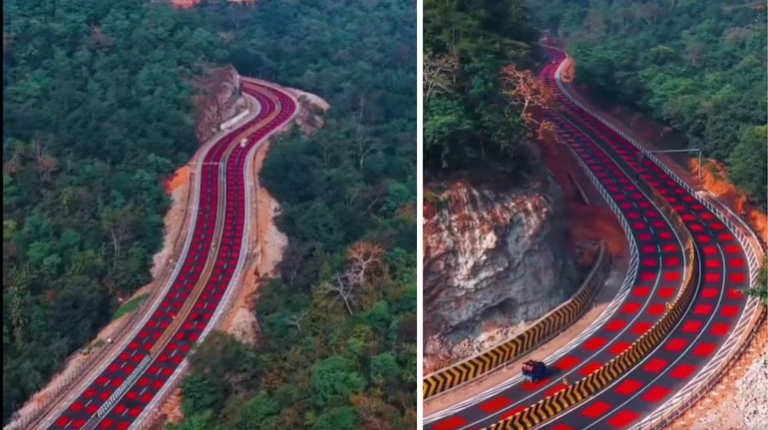
According to ANI News, entire hillsides within the eco-sensitive and buffer zones have been carved open. Dust clouds rise over once-green valleys, coating leaves and lungs alike. What was meant to be a protected corridor for elephants, leopards, and tigers has turned into a quarrying belt.
The anatomy of exploitation
The Dukhra range has become the epicentre of unchecked extraction. Blasts echo across forest ridges, scaring away wildlife and fracturing soil layers that hold underground water. The government recently declared Similipal a national park—the second in Odisha after Bhitarkanika—but on the ground, the transition means little. The same stone mining operators continue under new names, shielded by local contractors and political patrons.
Wildlife rangers admit privately that their patrol vehicles are outnumbered by stone mining trucks. Permits blur the line between legal and illegal stone mining. Each truckload removes not only rock but trust—in law, in oversight, in protection.
Displacement in every direction
With forest cover gouged out, animals are forced into neighbouring farms and villages. Reports from Mayurbhanj show tigers, elephants, and deer entering croplands at night. Villagers build fires and fences, but fear grows with each encounter. The spike in conflict is not coincidence—it is displacement.
When the forest no longer feeds or shelters them, animals move toward humans. And when they do, the first victim is usually the animal. The story of Similipal’s stone mining is therefore not only one of greed but of induced conflict, where government neglect engineers violence between species.
The human cost of dust and deceit
Illegal stone mining does not end at the forest edge. The same dust choking trees now hangs over villages. People in Mayurbhanj complain of coughing, burning eyes, and sleepless nights as explosions shake their walls. Doctors report rising cases of asthma and chronic bronchitis. The health impacts, once anecdotal, have become generational.
Airborne silica and heavy-metal particles linger for days, settling on crops and ponds. Farmers say yields have dropped as leaves turn grey with dust. The irony is brutal: while wild animals flee the forest for safety, villagers breathe the price of extraction. What began as an environmental crime has evolved into a public-health crisis.
Even in its new status as a national park, Similipal remains a battlefield of competing interests. Local officials routinely promise crackdowns, but the machinery of corruption moves faster than enforcement. Quarry owners pay fines and continue operations under “temporary clearances.” No licence is ever truly revoked. The pattern repeats—profit, protest, paperwork, silence.
A betrayal carved in stone
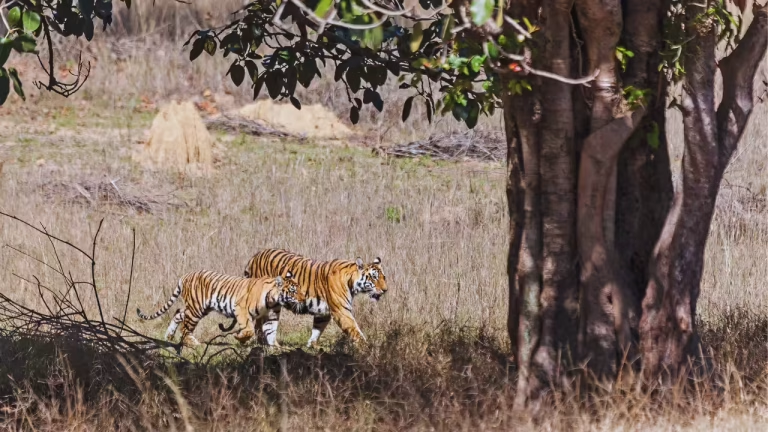
Similipal’s designation as both tiger reserve and UNESCO biosphere reserve once meant something. It represented an international commitment to protect a landscape that shelters Bengal tigers, Asian elephants, gaur, and the four-horned antelope. Today that promise reads like fiction.
Stone mining here is more than an ecological offence; it is administrative complicity. When inspectors visit, the blasts pause for a day, the machines are covered, and the noise subsides. As soon as they leave, the drills resume. The government’s claim of “immediate action” is as hollow as the hills it allows to be dismantled.
Extraction inside tiger landscapes is not random—it thrives where accountability is weakest. Each illegal pit is a monument to deliberate blindness.
Fragmented forests, fractured futures
The forest once acted as a natural sponge, absorbing rain and feeding rivers like Budhabalanga and Khairi. Now, runoff from mining sites carries silt and chemicals downstream, poisoning water and eroding riverbanks. Climate resilience, once anchored in dense canopy, is being stripped alongside the rock.
Conservationists warn that Similipal’s core will soon become an island of green surrounded by a ring of quarries. Such fragmentation breaks animal corridors and isolates breeding populations. Tigers that cannot disperse face genetic stagnation; elephants without routes turn violent.
The keyword stone mining here is more than a physical act—it is a metaphor for political erosion. What remains of governance is being chipped away by greed.
The community caught in between
Villagers near Dukhra have begun speaking out, not as activists but as survivors from stone mining. They describe nights lit by explosions and days filled with dust storms. Their protests are often dismissed as “anti-development.” Yet all they demand is the right to breathe clean air and live without constant fear of wildlife entering their courtyards.
Some local youth groups have joined wildlife volunteers to track trucks and report violations, but retaliation follows swiftly. Threats, false cases, and intimidation are common. Without independent oversight, community resistance remains fragile.
What protection still means
Similipal’s crisis raises a simple question: can a national park still be called protected when its borders tremble under dynamite? Enforcement agencies act only after viral videos appear. Until then, the state counts tourism revenue while ignoring the true cost of exploitation.
The park’s animals cannot speak for themselves, but their movement tells the story—paths that once led through forest now skirt pits and debris. Tigers recorded on camera traps in 2018 have not been seen since. Leopards linger near villages, scavenging livestock carcasses left by miners.
The government’s assurance of “immediate action” is less a promise than a ritual phrase. The real action would be permanent closure of all quarries within ten kilometres of the reserve and criminal prosecution of the operators. Anything less is participation in stone mining.
Lessons from the rubble
Similipal’s fall is not inevitable, but time is thin. Restoration will take decades, and only if extraction stops today. India’s tiger reserves are not mining blocks; they are living archives of resilience. The stone beneath Similipal’s soil holds history older than any policy—each layer cut away erases part of the planet’s memory.
If the state continues to trade that memory for short-term revenue, Similipal will become another statistic in a ledger of extinction. When dust finally settles on these hills, there may be nothing left worth protecting.
Source: ANI News, India
Photo: ANI News, India