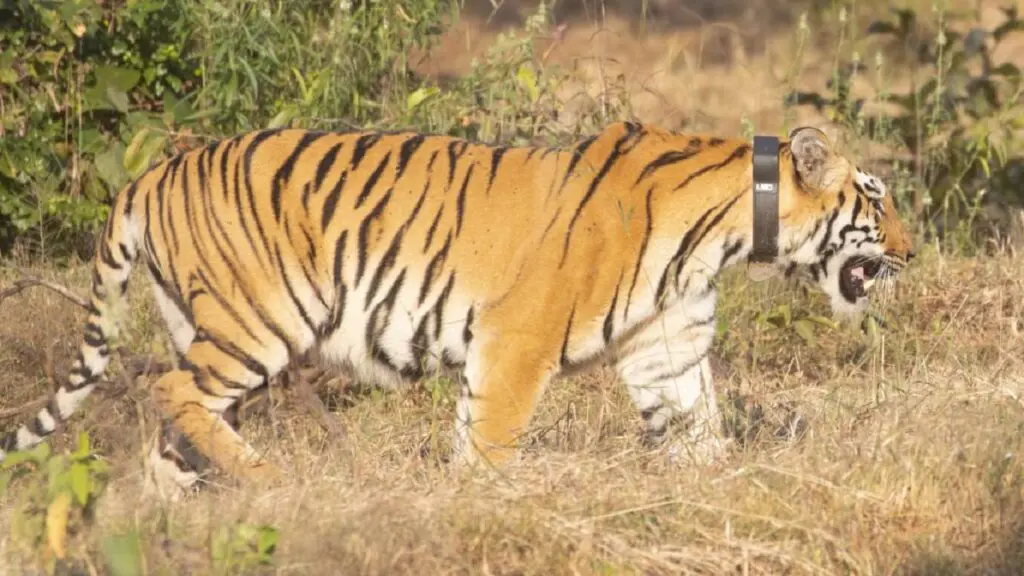
Sahyadri received a rare moment of hope this week as tigress STRT-04 walked out of her soft-release enclosure and into the forests of Chandoli National Park, beginning her independent life in the wild. As reported by Mid-Day, the release marks a significant milestone for the Sahyadri Tiger Reserve, a landscape that has struggled for years with low tiger density, fragmented terrain and chronic underinvestment. For once, the headlines are about a tiger entering a forest—not leaving it.
A Carefully Built Beginning
The tigress remained inside the enclosure for two days after the gates were opened, hunting and feeding with confidence before choosing to step out. Her behaviour showed that she carried the instincts necessary for survival in Sahyadri, a landscape where tigers have long fought for footing. The region spans Satara, Sangli, Kolhapur and Ratnagiri, yet the forest patches rarely function as a seamless habitat. Any tiger returning to this terrain faces a tight, demanding learning curve.
The rewilding programme prepared her incrementally. Experts monitored her adjustment from day one, tracking her kills, responses, marking behaviour and awareness of her surroundings. Veterinary teams ensured she was physically ready. Only when she demonstrated consistent wild-compatible behaviour did the final release proceed.
Video Credits: Video released by Wildlife Institute of India (WII)
Science As A Survival Tool
A radio collar now tracks the tigress around the clock. Satellite telemetry and VHF receivers guide multiple field teams from the Sahyadri Tiger Reserve, Chandoli National Park and the Wildlife Institute of India. Every movement pattern, every rest site, every early hunting attempt is being verified on the ground. In a landscape where human presence threads close to forest edges, such monitoring is not a luxury—it is a shield.
The key components of post-release tracking include daily ground checks, documentation of habitat use, rapid-response veterinary capability and measures to prevent avoidable conflict. This is essential in Sahyadri, where villages, plantations and settlement lines sit near wildlife routes. One wrong turn can expose a newly released tiger to livestock, fear, and retaliatory currents that have damaged so many rewilding attempts across India.
A Region Fighting For A Tiger’s Return
Sahyadri has battled instability for years: corridor degradation, forest pressures, delayed restoration, and a long absence of breeding females. The release of STRT-04 is not the end of those challenges, but it is a rare structural win. Field Director Tushar Chavan called the tigress fully fit for the wild, noting her confidence and readiness. Senior officials highlighted the science-led process—an approach Maharashtra has often promised but only recently begun executing with consistency.
This success also reflects the persistence of individuals who pushed the programme forward through bottlenecks and bureaucratic fatigue. Their work will only matter if the forest now receives the protection required to let the tigress establish territory without harassment, noise, encroachment or political interference disguised as tourism development.
A New Future—If Humans Don’t Spoil It
Some officials already speak of future tourism potential, eager for revenue before ecological stability has even been tested. This is where caution is everything. Sahyadri does not need tourists celebrating a novelty. It needs space, silence and absolute respect for the fragile foothold the tigress is carving. A single vehicle in the wrong place, a single disturbance near a kill site, a single push for expansion at the forest edge is enough to derail months of careful preparation.
Tigress STRT-04 represents more than one animal entering the wild. She represents the possibility that Sahyadri can still function as a tiger landscape if humans stop rushing to extract value from every conservation success. Her survival will depend on discipline across the entire region—restrained movement, protected buffers, and an uncompromising defence of the forest’s integrity.
In the end, her release embodies the principle behind real habitat practices: a tiger’s future expands only when humans shrink their footprint. Sahyadri has been given a second chance. Now the forest must be allowed to decide what comes next.
Source: Mid-Day, India
Photo: Mid-Day, India