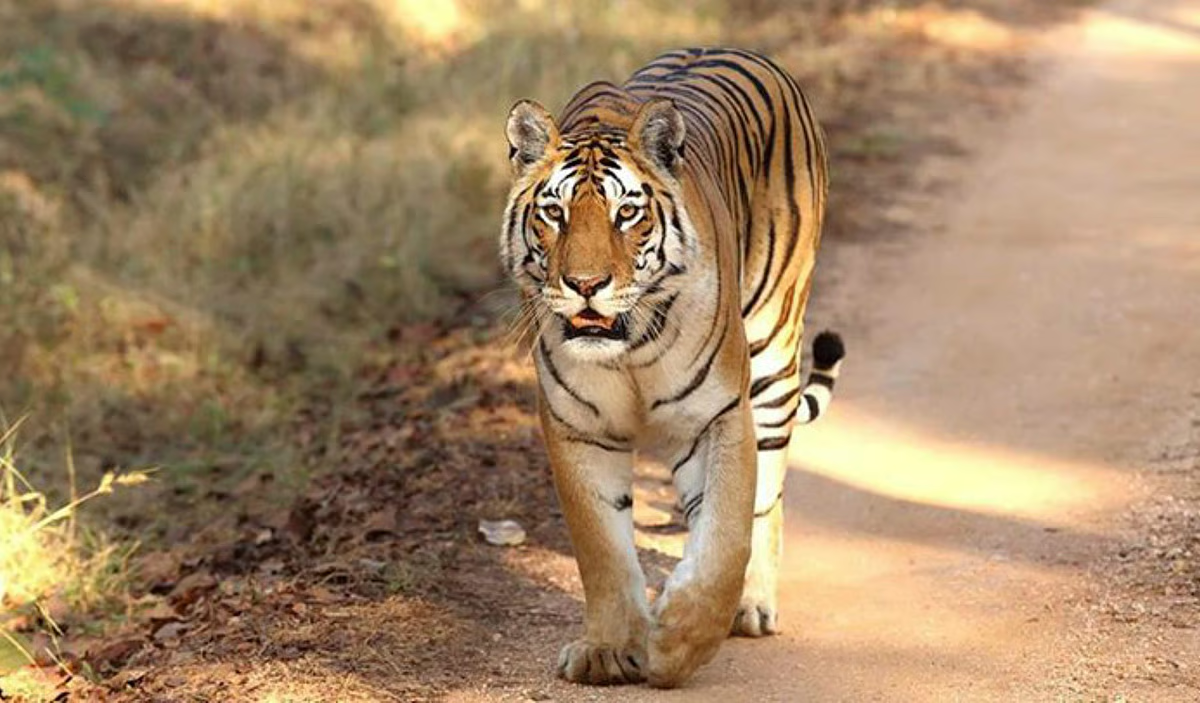
In the forests fringing Bandipur, Mysuru district has entered a moment that will decide whether India still believes in coexistence or whether panic has replaced principle. A farmer in Sargur taluk accidentally approached a drain where a tigress and her newborn cubs were resting. Startled, protecting her young, she reacted as every wild mother does. He died. A tragedy, human and real. Yet what follows now — the urgent Mysuru capture operation to trap her and three cubs — reveals something darker than instinct: a system that punishes nature for natural behavior, bends to outrage, and prioritizes political calm over ecological truth.
Forest officials describe this as the first-ever attempt to remove a mother tiger with cubs following a single fatal encounter at the forest boundary. They insist it is necessary. They say they fear for the cubs’ safety during darting. They speak of distress, logistics, and protocol. But the reality is simpler: this Mysuru capture is not science; it is fear-driven governance. A wild tigress defending her cubs in her territory has been recast as a threat. And once the public demands action, the state obeys urgency over ecology. One life is lost, four lives are sentenced.
The story, reported by New Indian Express, notes that the farmer unknowingly came close to the hidden cubs. It was an instinctive defensive reaction, not predation. The tigress was not hunting humans. She was protecting newborn life. Yet the language shifts immediately: rescue, capture, control, relocation, radio collaring. An unavoidable accident becomes justification for the Mysuru capture operation. And India’s forests lose another piece of freedom.
In conservation rhetoric, tiger mothers are symbols of hope. Cubs represent future strength. Yet here, they are treated as criminals’ children — trapped in cages before they can walk steadily. If the Mysuru capture succeeds, this family’s fate becomes a cautionary tale to the wild: if you defend your young near humans, you forfeit your place in your own home.
A death at the edge of survival
Rural India is built on routines shaped by necessity. Farmers move early, scan crops, walk creek beds and fringes. Tigers move too — especially young mothers carving territory on the edge of established ranges. Where forest and farmland kiss, life becomes negotiation. In this case, the tigress chose a quiet drainage patch to hide her cubs. The farmer stumbled too close. One step wrong, one instinct triggered, and tragedy unfolded. It was not negligence, not recklessness — just misfortune at the border of two worlds.
But border misfortune rarely ends symmetrically. The human receives compensation, community support, government intervention. The tiger receives surveillance, a cage, sedation plans, and the looming sentence of relocation. The Mysuru capture operation is presented as management, but in practice, it is punishment for instinct. India calls itself a tiger nation — yet reacts as though a tiger’s natural reaction is an act of aggression.
Crisis theatre instead of calm governance
Officials have flooded the terrain with patrols, veterinarians, cages, and even elephants. The tigress was sighted but not darted due to distance. Two cubs reportedly walked into cages already. The state imposed Section 144 for crowd control. This is not conservation; this is a security operation. It is the Mysuru capture as spectacle, driven by fear of backlash, not ecological reasoning. Villagers demand captivity. Officers promise collaring. Decision-making has become reactive theater.
Now the plan: capture all four, examine them, possibly release them deep inside the forest only if they pass medical checks. But once wild tigers are caged, their odds of return diminish. Bureaucracy likes containment. Fear likes certainty. Public anger likes visible action. And so the Mysuru capture marches forward, not because science demands it, but because governance fears appearing passive.
This is how India loses wildness: not in poaching rackets, but in moments when political calculation overrides ecological judgement. When a single fatal incident — instinctive, accidental — triggers removal instead of education and controlled monitoring. These 4 lives could remain wild with community support, patrol buffer, and awareness campaigns. Instead, the Mysuru capture treats them as liabilities.
When instinct meets administration
A wild tigress is expected to know rules humans refuse to follow. She should avoid field edges. She should sense risk where humans cannot. She should keep cubs deeper inside. Yet humans step into corridors, graze cattle near forests, burn field edges, dump waste, plant sugarcane cover. And when instinct meets intrusion, the animal pays. Instead of addressing the perennial human expansion into tiger fringe zones, the Mysuru capture shifts responsibility entirely to the animal.
Most disturbing is the justification: “first time such incident in recent times.” That should suggest rarity — a call for restraint. Instead, it is treated as precedent to respond aggressively, to satisfy public emotion, to show authority. And in that response lies the rot at the heart of conservation politics. When governments choose expediency, wildlife loses.
This Mysuru capture reflects more than situational panic — it reflects structural political failure. Instead of investing in coexistence infrastructure — buffer-zone outreach, real-time communication with villagers, patrol escorts for peak birthing seasons, quiet-movement advisories — the state defaults to force. Instead of building trust, it builds cages. Instead of teaching caution, it removes wildlife.
The myth of rescue vs the truth of removal
Authorities call this a rescue mission. They speak of safety, veterinary care, radio collars. But removal under pressure is not rescue; it is containment for political protection. The Mysuru capture is happening not because coexistence failed, but because the state fears criticism. One tragic death, and the system responds as if the forest itself committed an offense. When villagers demand captivity, the government complies. When a tigress defends her young, she becomes a case file.
Even the plan to “release deep inside the forest” is uncertain. Relocation success with newborn cubs is low. Stress, separation risk, unfamiliar territory — these factors threaten survival. And if they survive relocation, they join the long list of tigers pushed away from human edges instead of humans being educated about them. The Mysuru capture teaches the wrong lesson: protest gets results, tigers get moved.
What coexistence should look like
Real coexistence would have looked different. After the attack, officials could have:
- created temporary exclusion zones
- escorted morning field workers
- broadcast safety advisories
- posted trained staff at risky points
- used drones to track the mother
- protected cub concealment areas without intrusion
- secured community partnership instead of lockdown orders
This would honor both human life and wild life. Instead, the Mysuru capture reduces nuanced conflict to a headline response. The tigress acted as any mother would. The system reacts as a political machine does — quickly, visibly, at the expense of nature.
The consequence of choosing fear over understanding
India celebrates tiger numbers but fears tiger presence. The Mysuru capture is not a story of safety — it is a story of fear disguised as duty. If this tigress and her cubs are removed because she defended her young, what message lives in the forest? What precedent spreads across Karnataka? The next first-time mother at the edge of Bandipur or Nagarahole may face the same fate — removal before education, capture before understanding.
Coexistence is not a slogan. It is a practice. It requires patience, training, and dignity for both species. When tragedy strikes, true leadership calms communities, deploys reason, and strengthens prevention. Weak leadership cages wildlife and calls it protection.
The Mysuru capture will end in either freedom or confinement for a family that acted naturally. The question is whether Karnataka protects forests only in speeches, or in moments like this — when the wild tests human resolve. Coexistence demands courage from officials, patience from citizens, and respect for instinct. Unless that culture returns, this will be remembered not as a rescue mission, but as the moment a mother and cubs lost their home to fear, and a region lost a chance to prove coexistence still lives.
Source: New Indian Express, India
Photo: New Indian Express, India