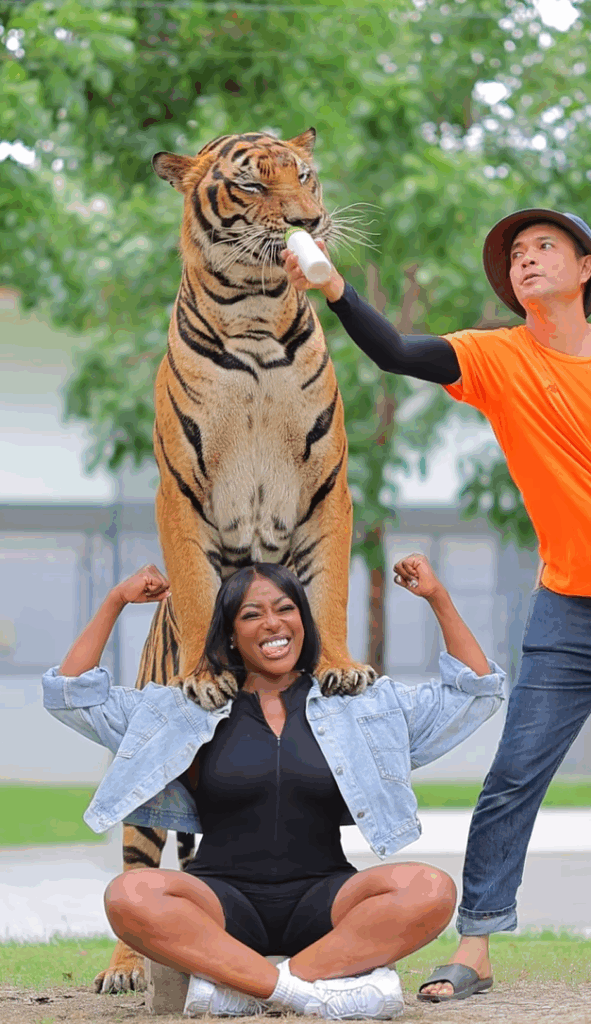
When Nigerian actress Ms DSF posted her tiger photo shoot from Thailand, the internet ignited. Fifteen million people watched as she posed with an adult tiger, its paws draped over her shoulders while two handlers distracted it with a bottle of milk. The video, filmed at Tiger World in Nakhon Pathom, became an instant hit — an image of confidence, faith, and fearlessness. But what looked like courage was captivity polished for the camera.
The theatre of control
Tiger World markets itself as an educational attraction, a place where visitors can “learn” about wildlife. What they learn instead is dominance. Tigers there are subdued, not serene — conditioned through drugs and discipline to remain still as tourists approach. For many, sitting beside a sedated predator feels like a spiritual experience. In reality, it’s a commercial exchange: money for proximity, image for silence. Each tiger’s stillness hides exhaustion, each photo another small extinction.
When influence becomes indulgence
Ms DSF captioned her post, “Exercising my free will and trusting God.” Her followers saw bravery; others saw denial. That contrast reveals how easily social media distorts ethics. In an age where risk equals relevance, captivity becomes content. What viewers perceive as “trusting God” is really trusting control — the control of handlers, tranquilizers, and a system that mistakes submission for peace.
It also exposes how our collective behavior toward wild animals has drifted from respect to entitlement. The more we crave interaction, the less we understand freedom. Modern tourism teaches that touching a tiger is proof of love, when it is proof of power. Influencers like Ms DSF unintentionally turn domination into aspiration. Each viral image rewrites the meaning of courage — not as restraint, but as intrusion.
The spectacle of sedation
According to the IOL report, two animal handlers stood close during the shoot, holding a milk bottle to distract the tiger as photos were taken. The animal’s compliance was not calm; it was conditioning. For audiences scrolling past, the image appears serene because cruelty is now curated to look gentle. Fifteen million people saw a moment of apparent harmony — yet almost none questioned what keeps a predator motionless for a human portrait.
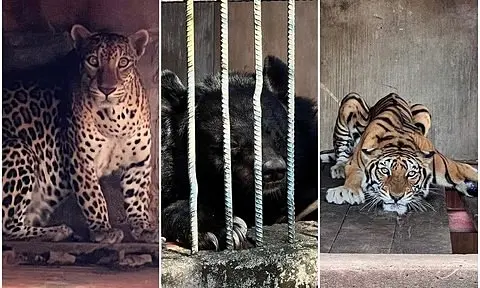
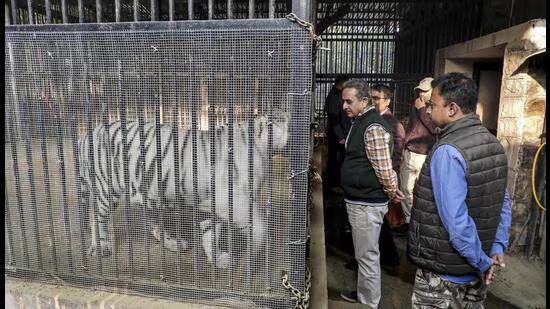
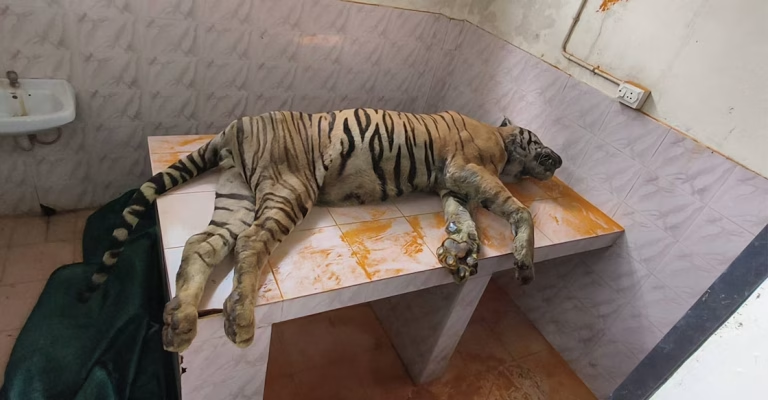
Across Asia, tiger entertainment centres replicate this illusion. Tourists like Ms DSF queue to stroke, feed, and pose, thinking they are witnessing majesty. What they’re really witnessing is manipulation. Tigers bred for selfies are raised in cages, their cubs taken early, their adulthood spent sedated until death. These places sell connection while destroying it.
The currency of cruelty
The tragedy isn’t that Ms DSF wanted to experience something wild. It’s that her post turned confinement into a trend. Millions now see her image as a symbol of boldness, unaware that it normalises cruelty. Each click, share, and comment reinforces demand for more tiger encounters, more human validation, more control disguised as closeness.
The handlers appear gentle, the setting calm. But underneath is fear — the animal’s, not the tourist’s. What seems spiritual is mechanical: a perfectly timed sequence of sedation, feeding, and posing. These scenes strip tigers of their essence and audiences of their conscience.
Learning the wrong lesson
Social media thrives on spectacle. Platforms reward attention, not awareness. For every voice questioning ethics, thousands celebrate thrill. This imbalance is deliberate — outrage is fleeting, profit is permanent. Influencers like Ms DSF are not villains; they are symptoms of a world that mistakes beauty for consent. The real story is not one woman’s video, but a culture that still sees the tiger as a prop, not a presence.
If there is any lesson in this stupity of Ms DSF, it’s that the wild does not need admiration. It needs distance. True courage is not sitting beside a tiger — it’s ensuring that no tiger ever has to sit beside us again.
Source: IOL, SOuth Africa
Photo: IOL, SOuth Africa