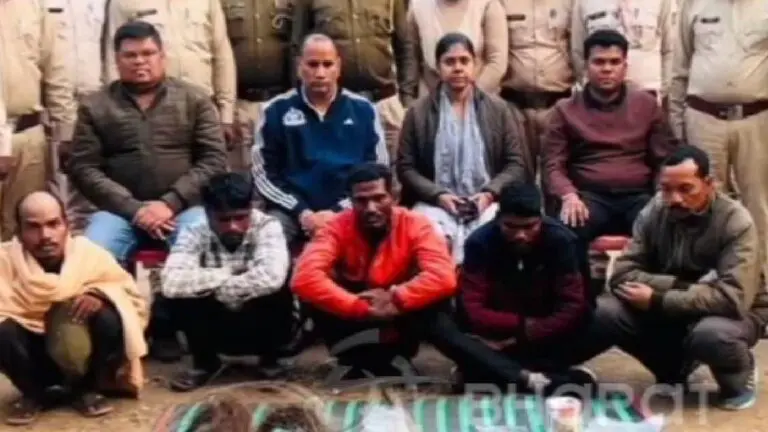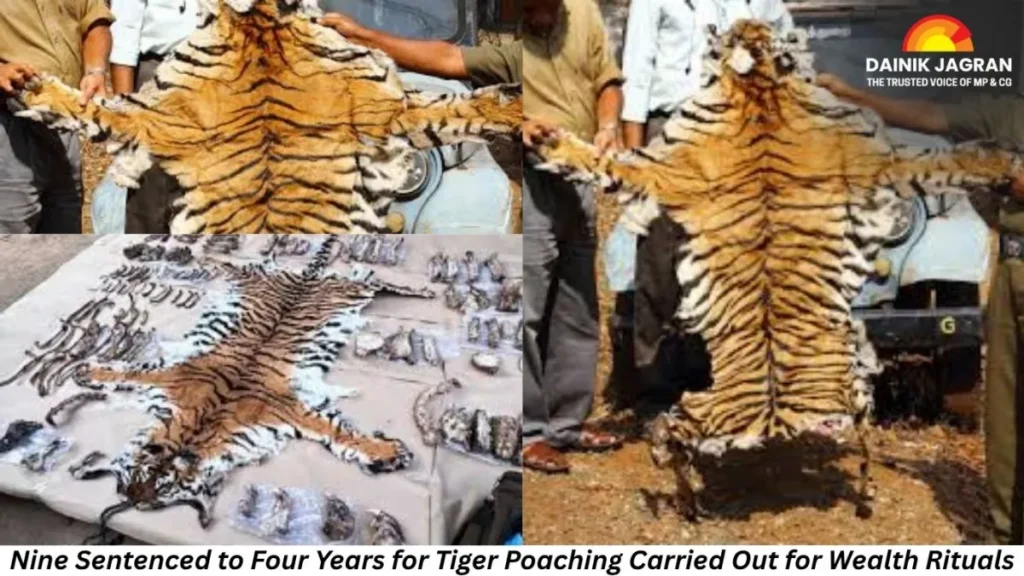
Money rain is the phrase that now sits at the centre of one of Madhya Pradesh’s most disturbing tiger poaching cases, where superstition and organized crime collided inside the Satpura Tiger Reserve. As reported by Dainik Jagran, a Narmadapuram court sentenced nine members of a hunting gang to four years of rigorous imprisonment for killing a tiger to fuel an occult ritual promising sudden wealth. What unfolded in this case exposes not just ignorance, but the deliberate brutality of networks that treat a tiger’s body as currency and cloak their violence in superstition.
A Ritual Built On Violence And A Tiger’s Final Moments
The crime dates back to December 2018, when teams from the State Tiger Strike Force and Satpura Tiger Reserve raided a makeshift hut near a girls’ hostel in Kamti village. Four men were caught performing rituals using a tiger skin and its whiskers—an act meant to trigger the money rain fantasy, a belief that certain body parts could summon prosperity. Investigators found three severed paws, twelve claws, and additional whiskers arranged as part of the ceremony. These were not trophies; they were mutilations engineered for profit, ignorance, and the thrill of illicit power.
The money rain gang had built their ritual on the idea that killing a tiger could force fortune itself to shift toward them. But beneath the theatrics lay a clear commodity chain: claws for charm markets, whiskers for black-magic practitioners, paws for ritual brokers—all moving through the same illegal routes that have kept tiger trafficking alive for decades.
A Network That Stretched Across Two Districts
The first arrests—Hemant alias Babloo Batti, Omprakash, Jayprakash and Chamansingh—barely scratched the surface. Interrogation revealed five more men, drawing investigators into a broader money rain web running across Narmadapuram and Chhindwara districts. The gang operated like countless others in central India: loosely organized, but deeply linked to local superstition markets and trafficking intermediaries.
Money rain was not a belief they stumbled into; it was the hook used to justify a killing they intended to profit from. These networks exploit superstition because it provides a convenient story to mask a straightforward business model: kill, dismember, sell.
Authorities recovered hidden tiger parts at Hemant’s prayer spot—a detail that shows how easily poaching embeds itself inside everyday spaces, where evidence can be disguised as ritual material. These men were active participants in a criminal chain that feeds on India’s most endangered wildlife.
A Rare Court Decision That Refused Leniency
The Wildlife Protection Act is often undermined by weak enforcement or soft sentencing, but not in this case. The court called the crime “extremely serious,” denied any leniency, and convicted all nine under Sections 9 and 49B. Four years is still far below what such an act deserves, but the refusal to dilute the punishment matters in a landscape where poachers frequently slip back into the shadows.
Yet even here, the sentence reflects a much larger problem: poaching thrives not because courts fail, but because the supply chain rarely breaks. For every gang convicted, several more move quietly through the same forests, fueled by demand that sees a tiger not as a living apex predator but as a catalogue of body parts.
The Tiger At The Center Of This Money Rain Violence
Lost in legal language is the tiger itself—the individual whose life was reduced to paws, claws and whiskers. Tigers in reserves like Satpura navigate shrinking space, rising pressure and human activity on all sides. When one is killed, the loss tears through the fabric of the reserve: fewer territorial anchors, fewer breeding opportunities, more ecological instability, and a direct blow to India’s fragile tiger populations.
Money rain rituals expose a darker truth: superstition becomes an alibi. It sanitizes violence. It disguises greed. And it reinforces criminal networks that already feed off myth, fear and economic desperation, while pushing tigers toward extinction one body part at a time.
A tiger didn’t die because nine men believed in money rain — it died because its body was worth more to them cut apart than alive in the forest. The claws, the whiskers, the skin, the paws — every piece had a buyer waiting. This is what poaching really looks like: not desperation, not superstition, but a market that rewards brutality and encourages men to turn a living tiger into currency. One animal gone, nine men convicted, and an entire shadow economy still ready for the next kill.
Source: Dainik Jagran, India.
Photo: Dainik Jagran, India.