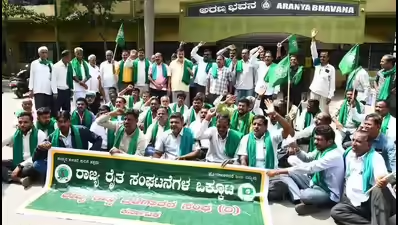
When Karnataka moved to upgrade Male Mahadeshwara (MM) Hills Wildlife Sanctuary into a tiger reserve, the public hearing turned into a battleground. Villagers, seers and tribal groups protested, fearing loss of grazing rights and restricted forest access. As reported by the Times of India, their anxiety is real. Yet conservation cannot be held hostage by short-term politics and fear. MM Hills locals are defending customs and votes; tigers are fighting extinction. The balance has to tip toward the wild.
Why the tiger must come first, now
MM Hills locals have legitimate worries: crop loss, livestock deaths and blocked paths to sacred temples. These costs are immediate and personal. But look up from the village edge and the broader fact is stark: tigers have already lost roughly 95 percent of their historic habitat. Allowing political cycles or parochial interest to lock in the remaining fragments guarantees extinction. If conservation is about anything, it is about making difficult, sometimes unpopular choices to preserve species that cannot protect themselves. Not to listen to MM Hills locals or politicians. That is the moral calculation here.
The region’s ecology is not an abstract resource; it is a functioning corridor linking Cauvery, Sathyamangalam and BRT reserves. Without secure habitats, those 23 counted tigers in MM Hills cannot persist. When MM Hills locals in some meetings demand zero change, they ignore the longer view: no reserve means no tigers. No tigers means humanity has failed. The choice is blunt—prioritise the present conveniences of a few, or the survival of a species that is irreplaceable.
Politicians, votes and the cheapening of stewardship
The role of an MLA (Member of the Legislative Assembly) is to represent constituents in state government. In MM Hills, some local politicians have sided with protesters, not because they resist extinction but because vote-winning is easier than leadership. An MLA who fans local opposition to gain short-term advantage is not defending villagers so much as exploiting them. That tactic corrodes trust in conservation: politicians escalate conflict to secure ballots, then abandon long-term solutions once the cameras move on. MM Hills locals deserve representation, not manipulation.
Conservation requires resilience, not performative promises. Officials must make clear that protections are not punitive; they are survival policies backed by compensation, alternative livelihoods, and active participation. The conversation should move from “resignation” or “resistance” to shared stewardship. But it must not be hostage to electoral calculation.
Sacrifice is not a slogan — it is planning
You can phrase this as sacrifice if you must: safeguarding tiger habitat will mean giving land back to the forest and altering human use. That does not mean abandoning people. It means planning for transitions—payments for ecosystem services, guaranteed grazing zones outside core areas, relocation where necessary, and investments in community-led tourism benefits. Saying the world must sacrifice for tigers is not a call to harm people. It is a demand for reallocation of resources and priorities so that wild species have a chance. MM Hills locals must be partners in that process, but partners who accept the scientific realities at stake.
Behavioral change is required on both sides. People used to free access must adapt to restrictions that are temporary only if communities receive fair compensation and long-term economic alternatives. Governments must enforce anti-poaching patrols, secure corridors, and dismantle illegal networks that profit from wildlife crime. It is a change in how societies prioritize non-human life. Our cornerstone discussion of behavioral change shows how public sacrifice, when planned and just, restores ecosystems — and with them, long-term human security.
The narrow path forward
Practical steps are straightforward: postpone any declaration until a transparent, door-to-door consultation is complete; establish clear, legally binding safeguards for tribal rights; fund immediate compensation schemes; and create co-management councils where MM Hills locals hold veto power over local implementation details. But only if it helps tiger conservation, not if it stops it.
At the same time, deploy strengthened patrols, forensic capacity, and prosecution teams to ensure that poachers and corrupt officials cannot exploit any temporary calm. Put simply: do the hard work before drawing a reserve boundary that traps people and tigers together without safeguards.
If communities, like of the MM Hills locals, still refuse to accept ecological realities after genuine, participatory planning, the state must be prepared to protect the habitat regardless. That’s an uncomfortable sentence to read, but extinction is permanent; the temporary discomfort of a few cannot justify the permanent loss of an entire species. Policy-makers must choose the long-term integrity of the landscape over short-term popularity.
On whose side are we?
MM Hills locals are not villains. They are people with histories and needs. Some will adapt; some will resist. But when an MLA turns local concern into political fuel, he is choosing optics over outcomes. Our duty as conservationists is to choose the tigers. Not because humans don’t matter, but because species cannot lobby for themselves, and the planet’s moral ledger already favors those who have sacrificed most of their world. Prioritizing tigers means prioritizing future ecosystems, climate resilience, and the moral project of reversing extinction.
The road will be bumpy. It will require money, legislation, and patience. It will require honesty about costs and uncompromising enforcement against those who profit from killing. But it will also produce a legacy: a functioning landscape where MM Hills locals and tigers coexist because both were deliberately protected—not because one was sacrificed quietly while politicians smiled. If leadership fails, the wild will pay the price. We must choose whom we serve.
Source: Times of India, India.
Photo: Times of India, India.