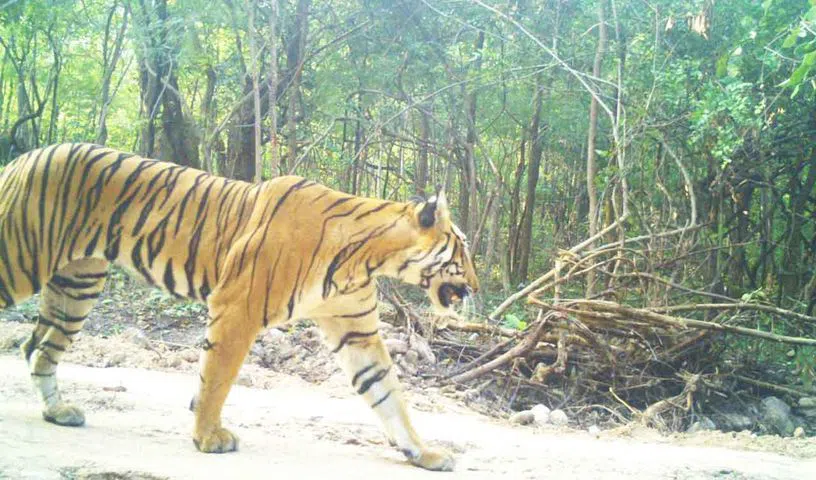
Mancherial has become one of the most revealing landscapes in India’s ongoing tiger recovery, as reported by Telangana Today, with migrant and resident tigers quietly reshaping a district once crippled by poaching and neglect. The return of these big cats, including two females believed to have crossed over from Maharashtra, shows that the forest still carries ecological strength despite years of violence. But their presence also exposes how fragile coexistence remains, especially in villages sitting directly on the edges of movement routes. Officials say the district’s resurgence reflects stronger patrolling and enforcement, yet every new arrival tests the limits of safety, planning and community tolerance.
Migrant Tigers Turn Mancherial Into A Testing Ground
One migrant, a female from Tadoba Andhari Tiger Reserve, entered Mancherial during the previous winter and settled inside the Luxettipet range. Identified as L1, she has stayed for nearly a year, moving predictably, leaving territorial marks and preying mostly on cattle. While her presence has caused some livestock losses, forest teams view her behaviour as relatively stable, noting that she has avoided direct conflict with humans so far. Her long stay confirms that the forest remains suitable for dispersal, even if the district lacks the structured corridors seen in more intact landscapes.
The second tigress to Mancherial, similarly believed to have come from Maharashtra, behaves very differently. For five months she has roamed between Kasipet and Tiryani mandals, frequently killing cattle and alarming villagers unused to consistent tiger presence. Officials monitor her as she scents trails, scratches trees and scatters scats across a wider arc than L1. Her repeated livestock kills may indicate unfamiliarity with local terrain or competition with other carnivores. Forest authorities stress that her behaviour requires closer study to prevent escalation, since unsettled tigers are more likely to drift toward villages or react unpredictably when startled.
A Forest Slowly Healing From Poaching And Pressure
Mancherial’s current revival contrasts sharply with its recent past. Between 2016 and 2023, the district witnessed multiple tiger deaths linked to snares, electrocution and targeted killing. A male tiger named Phalugna was electrocuted in 2016 after stepping into a trap set by hunters. Another tiger was found poached in Shivvaram in 2019. A third died between 2018 and 2019 in Bellampalli mandal after touching an electrified snare intended to kill carnivores entering grazing areas. These incidents revealed how deeply poaching networks operated and how poorly the region protected its wildlife.
Officials say change has been steady rather than sudden. Increased patrols, better monitoring, community awareness programmes and timely action against habitual offenders have all contributed to making the forests safer. Many villagers who once saw tigers as intruders now appear more willing to cooperate, though frustration rises whenever cattle losses increase. Traditional grazing practices still push livestock into forest interiors, intensifying the risk of encounters. Without compensation delivered quickly and transparently, tolerance can erode, making poaching more appealing to those who feel unprotected.
Residents Move Freely But Face Shrinking Safe Zones
Resident tigers, once nearly absent from Mancherial, now move with greater confidence. Several individuals have been photographed or tracked across forest beats, suggesting stronger breeding and territorial activity. Yet the region’s forests remain fragmented and overburdened. Unregulated grazing, expanding settlements, mining interests and the absence of formal buffer management place enormous strain on animals attempting to establish stable territory. Each cattle kill reflects underlying structural issues: reduced wild prey, degraded habitat edges and human activities expanding into spaces tigers traditionally used for movement.
Officials warn that Mancherial cannot rely on enforcement alone. The district needs organised grazing plans, dedicated movement corridors, landscape-level mapping and early-warning systems for communities in at-risk zones. Migrant and resident tigers cannot thrive without clear, safe pathways that prevent them from wandering into farms, roads or fenced properties. Multiple scat deposits and scratch marks left by the two females highlight how much the landscape is being tested by shifting territorial lines. Without ecological planning, the district may face more conflict in the coming seasons.
Mancherial’s rewilding shows that tigers reclaim landscapes the moment protection improves and corridors are defended. The district is now a living example of how dispersal depends on uninterrupted pathways, a truth explored further in detailed reporting on tiger corridors and their central role in sustaining movement across fragmented habitats.
Source: Telangana Today, India.
Photo: Telangana Today, India.