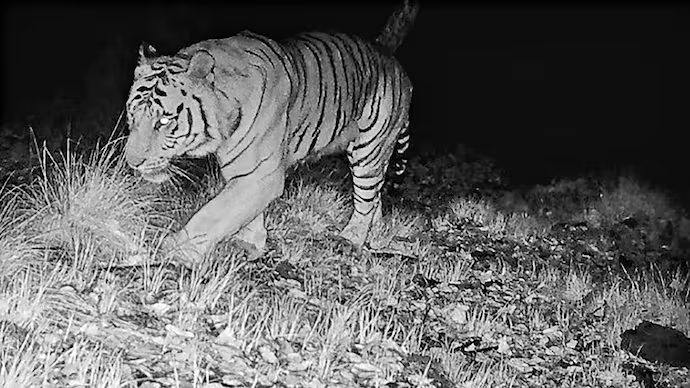
Is Malayan research on breeding captive tigers to be able to live in the wild again another trick in the Malayan government’s book? Weel tis rure looks like it. Malaysia’s universities are now expanding studies on the Malayan tiger. At first glance, it sounds like hope—science leading conservation. But behind the white coats and grant announcements lies a larger problem: research without release. When laboratories become more comfortable than landscapes, science starts serving its own survival.
Tigers in captivity, numbers on paper
The Vibes recently reported on new behavioural and breeding studies at Universiti Malaysia Kelantan (UMK). The program, led by Associate Professor Choong Siew Shean, observes tigers bred entirely in captivity alongside those captured from the wild. The aim of this Malayan research is to improve reproduction and “preserve ecosystem balance.” But the project’s focus on cages reveals the paradox of this Malayan research: the species it claims to protect can no longer exercise what defines it—freedom.
Tigers bred in confinement adapt to human schedules, not jungle seasons. Their instincts dull, their territories shrink to the size of fences. Each experiment promises insight, but each new enclosure pushes the species further from the world it evolved to rule, no matter what the Malayan research will say.
Science that stops at the gate
Dr Choong argues that natural breeding, not artificial insemination, helps tigers retain instinct. Yet every discussion of instinct becomes theatre when the subjects live behind bars. Field studies should begin where fences end. The real frontier for Malayan research lies not in veterinary campuses but in fragmented forests—where roads slice territories and logging camps multiply faster than tigers breed.
Habitat loss, the study admits, remains the core crisis. The forest corridors linking the Central Forest Spine are being devoured by plantations and infrastructure. Male tigers once patrolled multiple female ranges; now they pace boundaries they can no longer cross. Without territorial contact, no breeding plan matters. Still, Malaysia’s funding favours what is measurable: samples, surveys, statistics.
It’s the dilemma our science and tigers cornerstone exposed—research expanding faster than protection. We have data without duty, precision without policy.
When science replaces survival
This Malayan research also includes genetic studies confirming the species’ uniqueness. Yet uniqueness has become marketing language—justification for yet another paper, another conference. The wild population remains under 150 individuals, scattered and shrinking. Not one lab can guarantee their future without functioning ecosystems.
The deer-breeding project attached to UMK’s research highlights the same contradiction. Raising Sambar deer for tiger prey sounds logical, but these herds still live inside pens. Real tigers need real forests, not managed paddocks. Every ring-fenced experiment risks turning conservation into choreography—controlled, safe, and ultimately useless.
Even the concern over African swine fever becomes an argument for better wild monitoring, not more enclosure care. The food chain doesn’t collapse because of biology; it collapses because we replaced wilderness with paperwork.
Captivity as comfort
Captivity allows governments to claim success. It’s visible, fundable, photogenic. Ministers can cut ribbons in front of cages and call it commitment. Meanwhile, poaching networks expand, and forests thin. Research projects multiply like press releases, each promising to “save the Malayan tiger” but none addressing enforcement, corruption, or land conversion.
This is the silent failure of Malayan research: it makes extinction look organised. Every line of data becomes a form of denial—proof that we are studying the animal even as we erase its home. Universities mean well, but compassion without confrontation changes nothing.
What Malaysia really needs
The country doesn’t lack knowledge; it lacks translation from lab to landscape. For every behavioural chart, there should be a field patrol. For every breeding study, a restored corridor. Without direct application, this research becomes another zoo disguised as a syllabus.
Malaysia’s young scientists deserve better—to see their work matter beyond publication metrics. Real conservation means asking uncomfortable questions: Why are poachers still at work? Why do forest permits still pass? Why does every tiger project begin with enclosure funding, not forest recovery?
Malayan research can still redeem itself if it turns data into defense—science that challenges power, not shelters under it. The Malayan tiger doesn’t need more measurement. It needs space, law, and fear in the hearts of those who cut its forest.
Until that shift happens, the tiger will remain Malaysia’s most studied prisoner—and science its polite warden.
Source: The Vibes, Malaysia.
Photo: The Vibes, Malaysia.