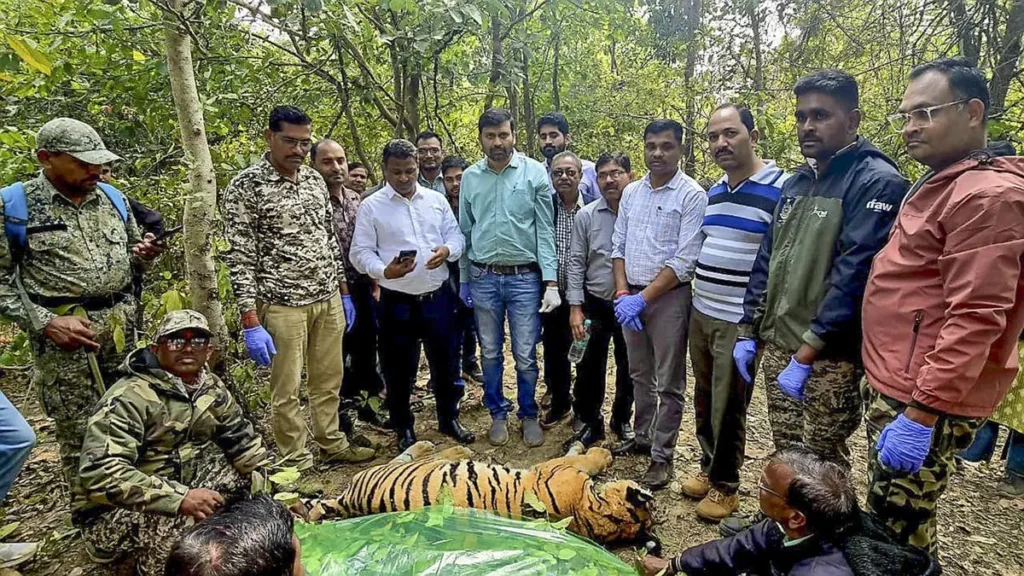
Maharashtra numbers have begun to tell a story darker than any forest legend. In just four years, from January 2022 to September 2025, the state lost 142 tigers and 537 leopards. The revelation came not through a press release or conservation report, but via a Right to Information request that pried truth from bureaucracy. Filed with the Principal Chief Conservator of Forests in Nagpur, the RTI transformed silence into data—and exposed how India’s celebrated tiger state is quietly bleeding out its big cats.
The numbers alone should have triggered a political earthquake. Instead, they’ve been met with indifference. Maharashtra numbers may now be the most precise indicator of a conservation system that measures decline but does little to stop it.
Maharashtra numbers expose a crisis in motion
According to the RTI data obtained by Bharat Speaks, Maharashtra’s tiger crisis has escalated with unnerving speed. In 2022, the state recorded 29 tiger deaths and 140 leopards. By 2023, those losses rose to 52 tigers and 138 leopards. In 2024, there were 26 tiger deaths, followed by 35 more in just the first nine months of 2025. Across this period, Maharashtra numbers remained grimly consistent: every year, leopards died in triple digits, and tigers vanished at an accelerating pace.
The cumulative total—142 tigers—represents not just ecological loss but institutional collapse. Of these, 84 deaths were labelled “natural,” 23 occurred in accidents, 29 from poaching and electrocution, and six remain unclassified. Conservationists warn that “natural causes” often mask human interference, particularly electrocution cases disguised as natural mortality.
Each death recorded under Maharashtra numbers reflects a deeper pattern: the failure of enforcement, the corrosion of accountability, and the triumph of indifference over science.
What the Maharashtra numbers say—and what they hide
The official Status of Tigers in India 2022 report lists Maharashtra’s tiger population at 444. On paper, this appears stable. In reality, Maharashtra numbers show that nearly a third of these tigers have perished in less than one term of government. Such losses cannot be explained away as coincidence or natural attrition.
Wildlife crime analysts describe how poachers along forest fringes use wire snares and electrified traps that kill silently. “Every claw, every bone, every pelt still has a buyer,” said one analyst. “The Maharashtra numbers only reveal the confirmed cases—we have no idea how many are hidden.”
This grim arithmetic underlines the central failure of India’s conservation model: it produces data faster than it produces deterrence. For decades, ministries have measured tiger survival through digital dashboards and camera traps, yet the system remains reactive. Maharashtra numbers expose how well the bureaucracy can count, and how poorly it can protect.
The road to extinction runs through data
Nowhere are these failures more visible than along the railways and highways that slice through tiger country. In Tadoba, Pench, Bor, and Melghat, tiger corridors have become linear death zones. Infrastructure projects approved in the name of progress have fragmented once-continuous forest landscapes.
The science and tigers cornerstone long ago warned that India’s infrastructure growth outpaces its environmental ethics. Maharashtra numbers now quantify that warning. Each accident, each road strike, each electrocution is a data point in an expanding obituary.
Officials describe many of these as “accidental deaths.” In truth, these are foreseeable casualties of systemic neglect. Every tiger run over by a train or electrocuted on a fence was the victim of a policy failure. When governments celebrate tiger censuses while ignoring corridor safety, Maharashtra numbers become nothing more than a public relations exercise.
Maharashtra numbers vs. political accountability
Despite its status as a model tiger state, Maharashtra has failed to translate research into reform. The tiger’s Schedule I protection under the Wildlife Protection Act of 1972 means little when enforcement remains starved of funding, manpower, and coordination. Prosecution rates for wildlife crime in the state linger below 10%, and many forest divisions operate with outdated communication systems.
The repeated publication of Maharashtra numbers through RTIs reflects not transparency but public desperation. Citizens are now doing the work the government should have done—tracking patterns, connecting deaths, demanding answers.
Inside the bureaucracy, however, this data serves a different purpose: it allows departments to claim documentation as progress. The Maharashtra numbers give an illusion of control, when in reality they only measure loss.
Even senior officers admit privately that field staff morale is collapsing. “We can write reports,” one ranger said anonymously, “but we can’t patrol with data sheets.”
Beyond Maharashtra numbers: the moral cost
At the core of this crisis is not a lack of science, but a deficit of duty. Maharashtra numbers demonstrate that knowledge without will is useless. When every tiger death is reduced to a line in a spreadsheet, it erodes the moral foundation of conservation itself.
Across the country, India is still lauded for housing three-quarters of the world’s wild tigers. Yet these Maharashtra numbers show how that legacy is being quietly eroded from within.
Each new RTI, each new statistic, each new press release documents an avoidable tragedy. In 2025 alone, 35 tigers died in Maharashtra, 21 of them “naturally.” But as conservationists point out, natural deaths are rare in healthy populations. Starvation, disease, or age seldom account for such high mortality—most “natural” cases are convenient bureaucratic fiction.
The result is predictable: Maharashtra numbers keep rising while accountability keeps falling.
What the Maharashtra numbers demand
The question now is not how many tigers Maharashtra has left, but how much longer India will tolerate a system where data replaces action. RTIs may reveal numbers, but they cannot substitute for justice.
Conservationists argue that the solution is not new reports but political reform: real-time patrolling, forensic tracking of wildlife crime, and transparent publication of mortality investigations. Unless this happens, Maharashtra numbers will remain the state’s conservation epitaph.
In the end, the tiger’s survival in Maharashtra depends not on counting, but on conviction. For a country that built its global conservation reputation on the tiger’s back, continuing to lose big cats at this rate is not an environmental issue—it is a moral one.
Maharashtra numbers, stripped of context, may look like statistics. In truth, they are obituaries written in the language of governance.
Source: Bharat Speaks, India
Photo: Bharat Speaks, India