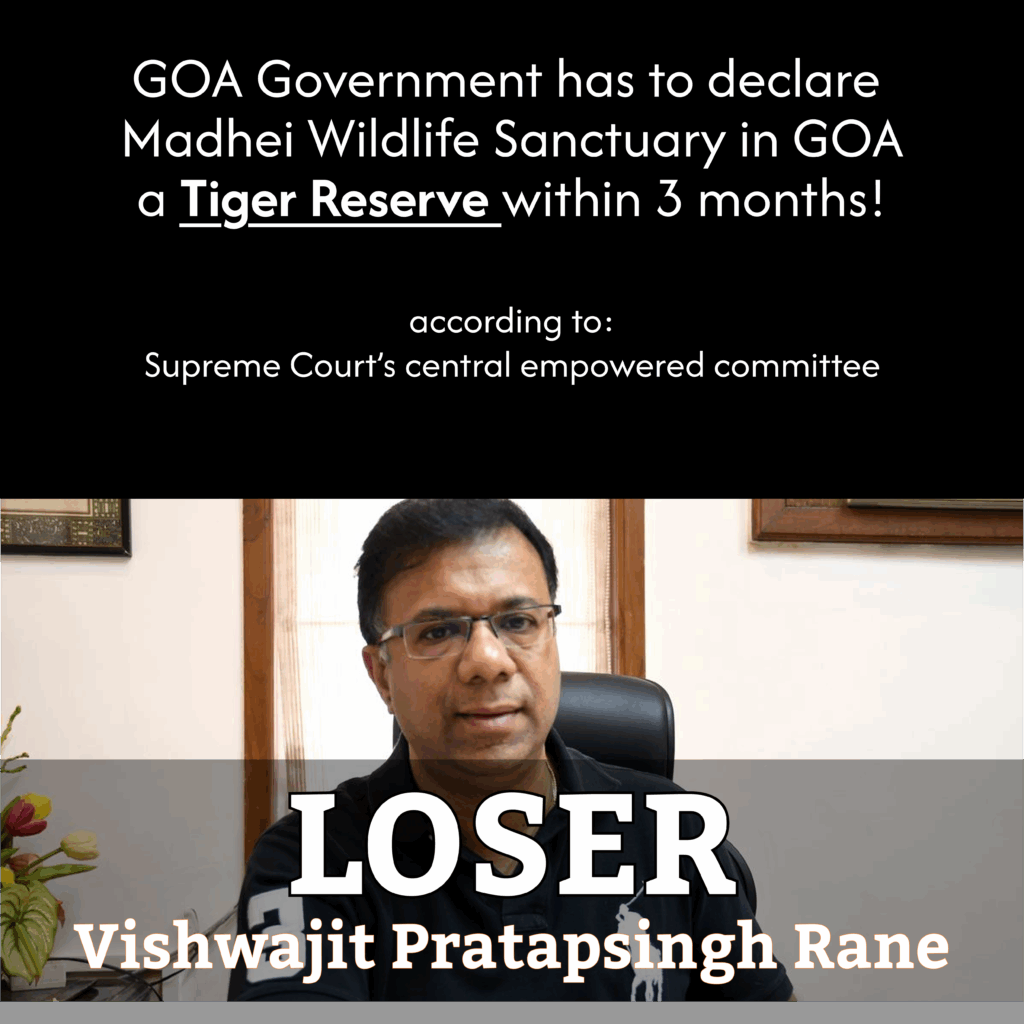
Madhei Tiger Reserve has finally been pushed toward reality after years of obstruction, as reported by Times of India. The Supreme Court’s Central Empowered Committee has ordered the Goa government to initiate notification of a 468.6 sq km tiger reserve within three months, ending a political battle that should never have existed. For years, conservation decisions in Goa were warped by political hesitation, unexplained resistance and the persistent belief that tiger protection could be delayed indefinitely. The Court has now made clear that the State no longer has that luxury.
The committee recommended Netravali and Cotigao Wildlife Sanctuaries as the core of the proposed Madhei Tiger Reserv, with additional areas forming its buffer. It also advised a phased approach, beginning with regions containing fewer households to minimise disruption. Meanwhile, public fears of displacement were addressed directly: declaring a tiger reserve does not automatically require relocation from buffer zones, nor the acquisition of private land. This clarity was long overdue, and the confusion flourished because of the State’s silence, delays and selective messaging.
How Madhei Tiger Reserve Became A Political Battlefield
The Madhei Tiger Reserve has become a symbol of political hesitation. The Goa government’s appeal against the High Court’s 2023 directive centred on arguments of autonomy and feasibility, claiming that protected areas already cover 20% of the State and that local populations near forest edges made tiger reserve creation unworkable. These claims, repeated for years, stalled progress and fed speculation about hidden motives behind the resistance for declaring the Madhei Tiger Reserve.
Many conservationists and observers questioned why such a small but ecologically critical State would resist a move that strengthens Western Ghats connectivity. Some suspected pressure from infrastructure lobbies seeking road expansion, river re-routing or extractive projects. Others believed the pushback reflected an entrenched political discomfort with conservation decisions requiring long-term commitments. Whatever the reason, Goa’s reluctance ensured years of wasted time in a landscape where time is the one commodity tigers cannot afford to lose.
The State’s own wildlife board had unanimously declared a tiger reserve “not feasible,” a stance contradicted by the CEC’s detailed assessment. The committee emphasised that the proposed reserve is fully contiguous with Karnataka’s Kali Tiger Reserve, forming an integrated 1,814 sq km protected landscape capable of supporting long-term population recovery.
The Madhei Tiger Reserve Built On Connectivity And Community Inclusion
The phased model proposed by the CEC ensures that areas with high household density will not be included immediately. Communities in Netravali and Cotigao, where households are fewer, are the starting point. This approach reflects a rare balance: strengthening tiger conservation while reducing community fear. It also underscores the truth that Goa’s argument about displacement was based more on political convenience than ecological reality.
The committee also detailed the ecological advantage of this move. The Madhei Tiger Reserve’s contiguity with Kali creates a transboundary conservation unit capable of sustaining natural dispersal, genetic exchange and a stable future for Western Ghats tigers. These are not abstract benefits; they are the foundations of long-term survival for a species cornered by shrinking habitats and political indecision.
This kind of landscape-level integration is what conservationists have advocated for years. Goa resisted not because of science but because of the discomfort of committing to a decision that could not be reversed easily — a decision that required leadership rather than evasion.
Goa Must Finally Choose Tigers Over Convenience
For years, Goa’s wildlife strategy has been shaped not by ecological responsibility but by political defensiveness. The prolonged resistance to Madhei Tiger Reserve has weakened the State’s credibility and damaged its conservation narrative. The Supreme Court’s intervention is therefore a corrective force, pushing Goa toward a responsibility it should have embraced without external pressure.
The government now faces a pivotal choice: comply with both the spirit and letter of the Court’s directive, or continue masking hesitation under procedural arguments. True progress means acknowledging that tiger landscapes deserve more than delays shaped by political calculations.
The future of Western Ghats tigers depends on landscapes like Madhei, Netravali, Cotigao and Mahavir remaining connected, protected and free from the corrosive influence of political posturing. Goa can still be part of this future — but only if it stops treating tiger conservation as a burden and begins treating it as a duty. That shift begins with honesty and ends with long-delayed notification rooted in responsible politics. So make the Madhei Tiger Reserve official.
Source: Times of India, India
Photo: Times of India, India