Kali has once again become a frontline example of how tourism pressures, administrative delays, and human encroachment collide inside India’s most fragile tiger landscapes, as reported by Deccan Herald. The Indian tiger authority (NTCA) has formally directed Karnataka’s wildlife authorities to act against illegal resorts operating dangerously close to the core area, exposing how deep structural neglect has allowed commercial interests to overshadow ecological responsibility. This development arrives after repeated complaints from conservation activists who witnessed violations ignored long enough to become a pattern rather than an exception.
Illegal Tourism As A Persistent Structural Threat
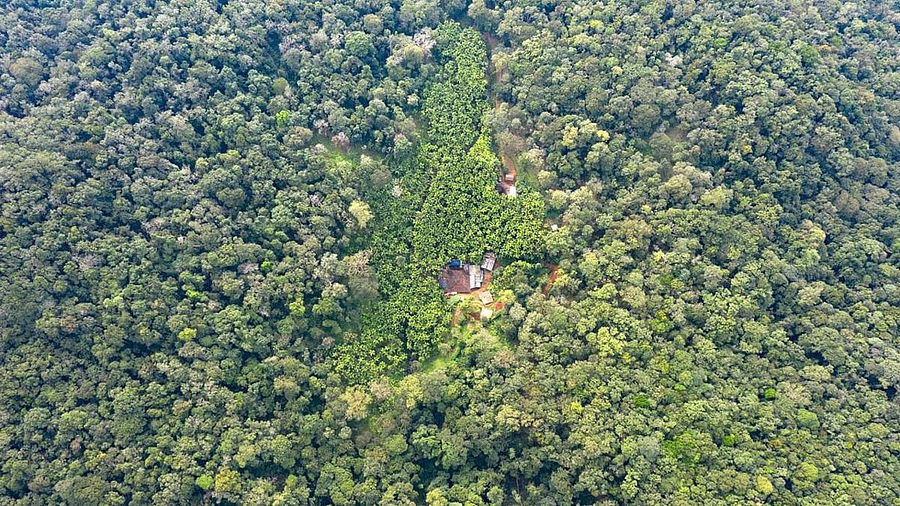
According to the grievance filed by activist Giridhar Kulkarni, numerous resorts, homestays, and hotels at Chavarli, Phansoli, and Virnoli were functioning within one kilometre of the core habitat, with at least one resort sitting barely 100 metres from the boundary. Such proximity disrupts movement, introduces light and noise pollution, and weakens the behavioural stability tigers need to breed and patrol their ranges. The problem is not new; it is the predictable outcome of years of land conversions, overlooked permissions, and a tourism model that prioritised demand over ecological law.
Kali has faced these pressures repeatedly, with tourism clusters swelling beyond what the reserve can absorb. The unchecked growth of homestays within the Castlerock Wildlife Range—an area notified as the Dandeli sanctuary—reveals the depth of the governance gap. Commercial operations surfaced without clearances from pollution control authorities, exposing tigers and local communities to risks that would never be tolerated in better-enforced landscapes.
A Failure Of Oversight, Not A Failure Of Knowledge
The NTCA’s intervention signals that the problem is not ignorance but inaction. Karnataka’s wildlife authorities have long been aware of the Supreme Court’s directives restricting tourism inside sensitive habitats. Yet illegal operations continued, showing how economic incentives shape decisions more strongly than ecological mandates. In landscapes like Kali, where corridors link larger tiger territories, such oversight failures become existential threats, fragmenting ecosystems that rely on uninterrupted space.
The activist’s complaint also drew attention to how rapid, unregulated development has blurred the boundaries between sanctuary and commercial area. When construction begins without scrutiny and businesses operate before receiving environmental permissions, an entire ecosystem becomes vulnerable. For tigers that depend on silence, predictable landscapes, and undisturbed pathways, the presence of resorts so close to the core transforms their world into a patchwork of noise and light.
Tourism That Pretends To Be Harmless Is Not Harmless
The NTCA’s letter underscores that tourism cannot continue to hide behind claims of community benefit while violating ecological rules. Illegal resorts do not support local families; they exploit legal grey zones and degrade the land that genuine community-led tourism depends on. Kali needs safe, regulated buffer activity—not commercial expansion disguised as sustainable development. With rising tiger movement across Karnataka, every unregulated structure increases the risk of conflict, displacement, and habitat degradation.
The High Court of Karnataka and the Supreme Court have both previously emphasised strict adherence to ecological boundaries around tiger reserves. Still, the violations near Kali highlight the gap between judicial orders and field realities. When rules are ignored, the pressure shifts back onto tigers, who must adjust to shrinking safe zones while navigating landscapes reshaped by noise, traffic, and human presence.
A Moment For Accountability, Not Cosmetic Action
The NTCA has now placed the responsibility squarely on the Karnataka forest department to enforce the law and dismantle illegal operations. This cannot become another symbolic exercise in issuing notices or collecting fines. Without decisive action, the ecological cost will continue rising, and Kali will inch closer to the fate of other reserves where tourism growth dismantled the very habitats visitors claimed to admire.
Real protection requires removing illegal structures, restoring damaged areas, and creating transparent systems that prevent repeat violations. It also demands planning that respects the reserve’s ecological function rather than Karnataka’s tourism ambitions. The state’s tiger populations depend on landscapes like Kali remaining intact, continuous, and free from commercial noise.
Don’t be mistaken, these are political failures. The building of these structures were allowed by local and regional politicians, who where just afraid that saying no or removing them would be not beneficial for their status. Enforcement only matters when institutions choose to act with urgency and integrity. Kali now stands at that crossroads, and what happens next will determine whether this reserve remains a living habitat or another cautionary tale of neglect hidden beneath the gloss of tourism.
Source: Deccan Herald, India.
Photo: Deccan Herald, India.