
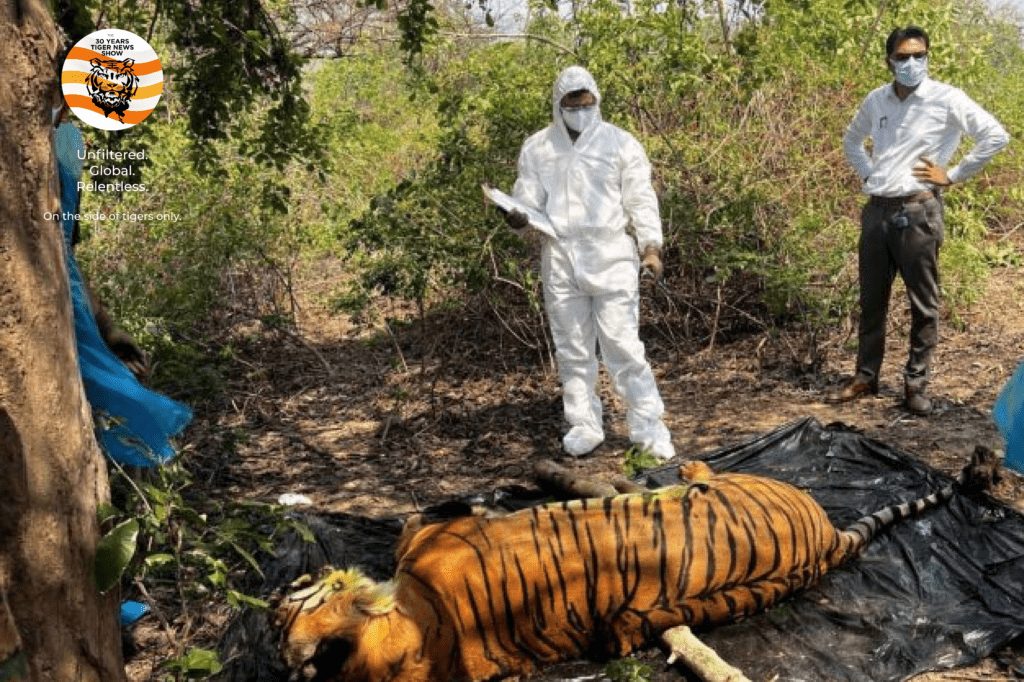
Kalagarh has recorded another tiger death inside Corbett Tiger Reserve, where a full-grown male tiger was found dead under mysterious circumstances, as reported by Garhwal Post. The carcass was discovered during routine patrol in the Dhara Block under Dhara Beat Compartment No 12, near an auxiliary stream of a natural water source. Forest officials said the tiger was found motionless around 9:10 a.m., after which senior officers reached the site for inspection. All body parts were reportedly intact, reducing immediate suspicion of body-part poaching. But intact body parts do not equal a clear death. They only narrow one part of the question.
The department conducted a combing operation around the site to look for traps, suspicious objects, poison traces or signs of human interference. Nothing suspicious was reportedly found. In Kalagarh, that is useful, but not final. Poison can vanish into bait, water, soil or scavenger activity. Internal injury can be invisible from outside. Disease can move quietly. Territorial fights can leave damage that needs expert reading. A tiger death inside one of India’s most important tiger landscapes should never be pushed into the comfort zone of “probably natural” before laboratory evidence arrives.
Kalagarh Must Wait For Science
Veterinary experts conducted a post-mortem under wildlife death protocols, with forest officials, staff and wildlife conservation representatives present. This tiger from Kalagarh was estimated to be between eight and ten years old. Internal organ samples and biological specimens were preserved and sent to the Indian Veterinary Research Institute and the Wildlife Institute of India in Dehradun. That is the correct process. The actual cause of death will only become clear after forensic, pathological and toxicology reports are received. Until then, every confident explanation is premature.
Kalagarh sits inside the larger Corbett landscape, one of India’s most prominent tiger habitats and one of the country’s strongest tiger population centres. That strength brings its own pressure. High tiger density can increase territorial clashes among adult males. Shrinking corridors, human interference, forest fires, injuries, poisoning, electrocution and old age all shape mortality risks in Uttarakhand. The state cannot treat each carcass as an isolated incident while the pattern around tiger deaths keeps widening across India’s most celebrated landscapes.
Dense Tiger Landscapes Still Fail Tigers
Officials said regular monitoring, camera traps and anti-poaching patrols continue in Corbett and adjoining divisions. They also said vigilance has increased during summer, when forest fire risk rises and wildlife movement near water sources becomes more frequent. That matters because water points can become danger zones: places of territorial pressure, conflict, disease transmission, human intrusion or poisoning risk. If a tiger is found dead near a natural water source, the surrounding ecology deserves detailed scrutiny, not just a checklist inspection.
Kalagarh also reminds us that tiger conservation cannot be reduced to population numbers. Corbett’s high tiger count is often used as proof of success. But a landscape with more tigers also needs more corridors, more dispersal safety, more veterinary intelligence, more conflict prevention, more fire control and more forensic transparency. Counting tigers is not the same as protecting them. A dead adult male in prime habitat is ecological information. The state must read it properly.
The uncomfortable truth is that every unexplained tiger death becomes a test of governance. Was this old age, territorial injury, disease, poisoning, electrocution or something else? Were water sources checked thoroughly? Were camera-trap records reviewed? Were nearby movements mapped? Were previous territorial encounters documented? Were human access routes examined? A serious investigation should answer those questions openly.
Kalagarh should not become another file closed by habit. The body may have been intact, but the landscape still needs answers. India’s tiger success story is only credible when every death is treated as evidence, not inconvenience. This case belongs inside the wider crisis of tiger deaths, where science must come before reassurance. Until the laboratory reports return, the only honest conclusion is uncertainty. A tiger is dead in Corbett, and uncertainty is not enough.
Source: Garhwal Post, India
Photo: Garhwal Post, India


