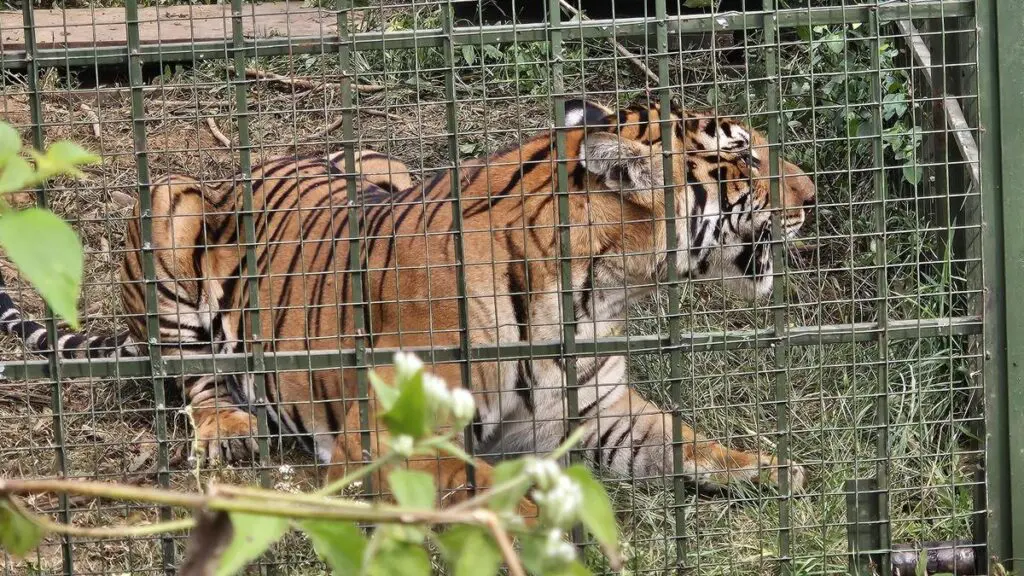
Gudalur enters the news again for reasons nobody in a forest-fringe community wants: a tiger pushed into conflict, a village pushed into fear, and a state machinery reacting only after a long, unnecessary struggle. As reported by Lokmat Times, a three-year-old male tiger that killed 13 cows across Devarsholai and nearby villages was finally trapped on Saturday after three months of tracking, complaints, and slow-moving intervention. The animal walked into a large cage shortly before dawn, ending an operation that should never have stretched this long. When conflict is allowed to simmer for months, both people and animals pay.
Three Months Of Predictable Escalation
The Gudalur forest division began receiving reports in early August about cattle kills. Instead of rapid mitigation, the response unfolded at a pace that mirrored administrative procedure, not ecological urgency. Forest officials eventually installed a massive cage—thirty feet long, ten feet high—brought in from Wayanad at the end of August. By then the pattern was well established: unprotected livestock at the forest boundary, easy access for a hungry tiger, and inevitable resentment among villagers. None of this was new; it was entirely predictable.
Camera traps confirmed the tiger’s identity by stripe pattern as it moved through vulnerable points along the fringe. A kill here, another there, each reinforcing the same message: the landscape invites conflict when livestock is left exposed and natural prey densities fluctuate. Villagers in Gudalur were repeatedly assured that action was coming. But action without planning simply shifts the problem from one moment to the next.
The Capture: Relief For People, Stress For The Animal
When the Gudalur tiger finally entered the cage, officials said it was vigorous and unsedated. The immediate plan is to shift it into a smaller transport cage under NTCA protocol, supervised by an authorised monitoring team. This will include NGO representatives and a ward councillor, ensuring documented procedures and transparency. The tiger will then be transported deep into the reserve forest, away from settlements.
This is the standard script: trap, shift, release. But relocation does not address the forces that produced the conflict. It only resets the clock. A tiger moved deeper today may be replaced by another tomorrow if the underlying landscape pressures remain unchanged. When cattle graze at the forest edge without protection, and when villages sit directly in a predator’s path, no relocation can compensate for the lack of long-term planning.
Media Disputes Overshadow The Real Issue
During the capture, friction emerged between media personnel and forest officials. Reporters claimed they were not allowed to film the operation, while revenue and police staff were reportedly given access. Forest officials maintained strict restrictions to avoid disturbing the animal—a reasonable call—but the moment devolved into yet another human drama around a trapped tiger.
This type of noise around a capture is familiar. The animal becomes a backdrop for competing narratives: officials defending procedure, media demanding visibility, villagers demanding safety. Meanwhile, the structural failures that allowed the conflict to grow receive less attention than the spectacle of the moment.
Gudalur Needs Structural Protection, Not Occasional Crisis Management
Officials described the capture as a major step in addressing human–wildlife conflict in the region. In a narrow sense, yes: one tiger will no longer appear in Gudalur’s cattle sheds. But regional safety cannot rely on caging one animal every few months. Conflict drops only when the landscape is managed with practical coexistence measures: secure cattle housing, immediate compensation, protected grazing zones, and early-response teams trained to intervene before a situation spirals.
Every livestock kill also signals habitat stresses. Tigers do not shift to cattle unless conditions around them are changing—prey fluctuation, disturbance, increasing human pressure. Without acknowledging this, captures become routine rather than rare. And each routine capture slowly erodes the idea of coexistence.
In Gudalur, people deserve relief, and tigers deserve better than being driven into traps because planning failed at the community scale. When conflict is treated as an episodic inconvenience rather than a structural issue, both sides lose.
The Gudalur relocation now planned is standard, and it may work for this particular animal. But sustainable coexistence cannot depend on crisis responses. It requires long-term investment, the kind described in conservation practices for tigers, accessible through this internal link to a broader framework for conflict reduction that prioritises prevention over pursuit.
Source: Lokmat Times, India.
Photo: Lokmat Times, India.