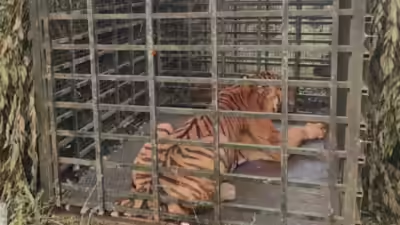
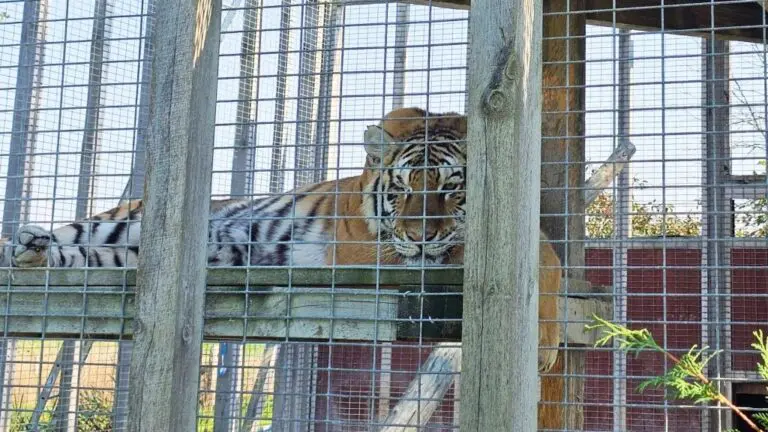
At the Fresno zoo, an 8-year-old female tiger named Batari has become the latest exhibit in the endless carousel of animal exchange that zoos call conservation. She was born at the Cincinnati zoo, transferred to Tulsa, and now stands behind glass in California — the fourth stop in a life never lived free.
While Fresno’s staff celebrate her arrival as part of the greenwashing “Species Survival Plan,” the truth is harder to frame for visitors: captivity is not survival. It is control dressed as care. As YourCentralValley.com reported, Batari “acclimated” quickly, learning her enclosure and her keepers. But adaptation under confinement is not health; it is resignation.
Fresno breeding
The zoo’s specialist proudly compared the breeding network to a “Match.com for tigers,” calling it a program to ensure healthy genetics. In practice, it functions like a closed registry that shuffles animals between cages under bureaucratic supervision. The female tiger Batari is paired, on paper, with a 250-pound male named Penari. They will not share an enclosure. They will meet only when humans decide the time is right, when hormone tests signal fertility. Then they will be separated again — an engineered intimacy that exposes the paradox at the heart of captivity. Tigers are solitary, yes, but solitude in the wild is chosen, not assigned. In zoos, every movement, every breath, is scheduled.
Captivity disguised as conservation
Fresno’s narrative is identical to hundreds of others: “part of a global effort,” “ensuring genetic diversity,” “educational value.” None of these phrases confront the fact that no zoo tiger will ever contribute to a wild population. Species Survival Plans (SSPs) claim to preserve lineages, but they preserve only dependency on captivity itself. The cubs born in these facilities grow into assets traded among institutions, not ambassadors for ecosystems. The irony is brutal — breeding animals whose offspring will never know freedom, to justify the existence of cages.
The language of “acclimating” and “comfort with keepers” hides the truth that stress manifests differently in big cats. Pacing, over-grooming, and lethargy are signs of psychological strain, yet they are often reframed as contentment. A tiger born in Cincinnati, moved to Tulsa, then Fresno, is not part of a conservation chain; she is a logistical product in a system that sustains itself by never ending.
Beyond Fresno
Every transfer like Batari’s reaffirms that zoos operate more like genetic warehouses than sanctuaries. They call it care; it is containment. They call it learning; it is voyeurism. If conservation were truly the goal, investment would go to protecting wild habitats, not building bigger viewing decks. Tigers do not need visitors. They need space, prey, and quiet. The global SSP model ignores the moral contradiction of protecting species by institutionalising their imprisonment.
While Fresno’s press release frames Batari’s arrival as success, it represents failure — the failure to defend the forests that could have been her home. When the zoo announces that another female, Dara, will soon be “relocated,” it celebrates a trade, not a triumph. There is no wild in these moves, only management.
Rewriting the meaning of protection
Real conservation means investing in the ecosystems where tigers still breathe without fences: Sumatra, India, the Russian Far East. It means defending corridors, dismantling trafficking networks, and funding patrol intelligence — not tranquilising, flying, and displaying animals under fluorescent light. The future of tiger protection will not come from Fresno or Cincinnati but from forests that remain unpaved.
Every zoo transfer like Batari’s deserves to be called what it is — not a rescue, not science, but captivity’s renewal. The tiger’s stripes remain beautiful even behind glass, but they are fading more and more as they no longer mean freedom.
Source: YourCentralValley.com
Photo: Fresno Chaffee zoo