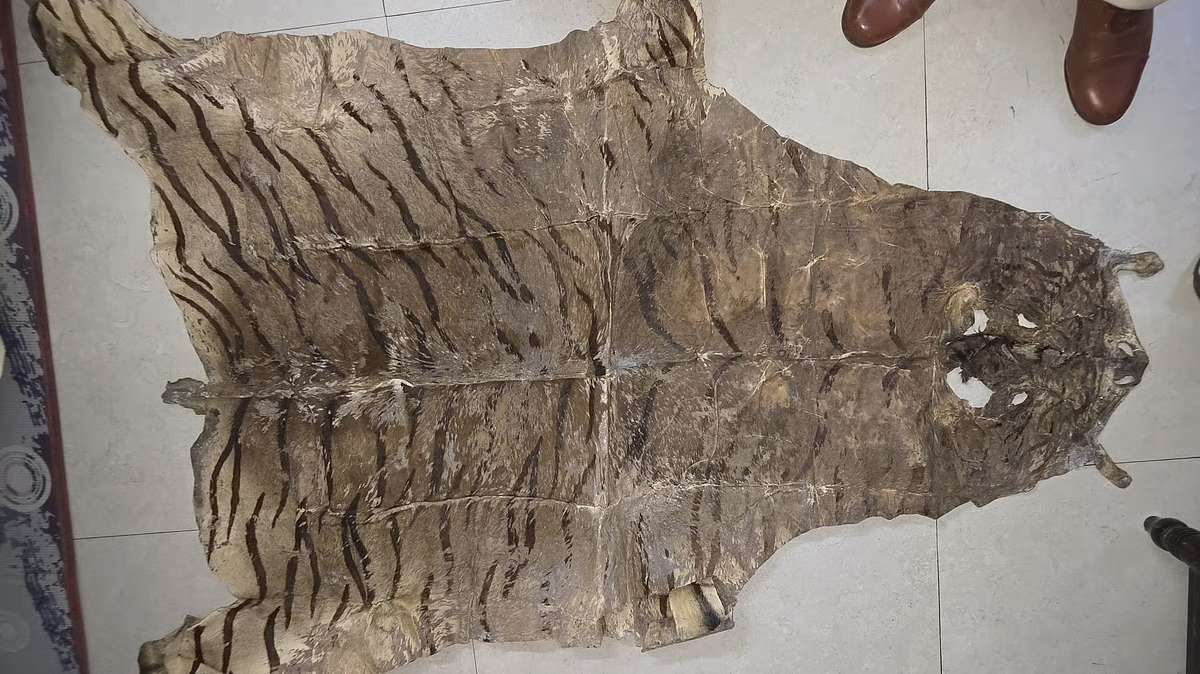
It was close to midnight in East Mandla when forest staff moved in — quietly, without lights, pretending to be buyers. Three men arrived carrying a rolled tiger skin. No drama, no panic, just business. That is the part outsiders rarely believe: tiger deaths here do not echo. They whisper.
Officers sprang the trap. Handcuffs clicked. The skin was seized. Faces dropped. And somewhere in the forests between Mandla and Kanha, a tiger had already been dead long enough for its body to be stripped, dried, and carried out by hands that knew exactly what they were doing.
The arrests — first two, then a third — were confirmed in a late-night briefing, reported by Free Press Journal. The accused claimed the tiger was killed by “someone else.” That sentence has been spoken so many times in central India’s forests it could be printed on seizure reports. But a tiger does not end up flayed and ready for sale because of confusion. Someone killed it. Someone skinned it. Someone believed there was money waiting.
And someone was right — until the officers showed up instead.
A tiger disappears in East Mandla long before a patrol reacts
Ask around East Mandla and you hear the same description: the edge. Crop fields, scrub, riverbend jungle, village tracks, the outer breath of Kanha. It’s where cattle graze, where farmers walk at dusk, where a dispersing tiger may pass without being seen. It is also where the forest administration is often a conversation behind reality.
The tiger died here — not inside a camera grid, not in a patrolled meadow, but in the soft blind corners around Atreya village, where villagers still speak low about “buyers” and “rates.” A tiger can vanish in that silence. And it did. The body is gone; the forest does not have it. Officials are still searching for bones, for claws, for the rest of the animal.
A sting operation is success only when the tiger is alive. When the skin surfaces before the alarm does, you do not celebrate — you take inventory of failure.
A marketplace shaped by belief, cash, and confidence the state moves slowly
Poaching in East Mandla doesn’t look like cinematic syndicates. It looks like a man who knows a wire. A man who knows a contact. A man who knows there will be someone willing to buy, whether for ritual, status, medicine myth, or simply because the black market has never lost appetite.
The officers pretended to negotiate. The accused explained nothing more than they had to. They thought they were selling a product, not carrying a crime scene. And their confidence matters — because confidence comes from history. Confidence comes from watching tigers vanish before and seeing life move on.
This trade has roots. It has quiet transport routes, trusted whispers, and brokers who do not speak loudly because they never need to.
This is the shadow economy that thrives whenever tiger poaching is treated as an isolated bust rather than an always-on system.
A tiger is gone; the question now is whether the network disappears or adapts
Officials are questioning the three. They say more suspects are being traced. They say they will find where the tiger died and who else handled the carcass. They will likely recover nothing but names and half-truths. Bones travel. Claws move. Fat is rendered. Everything that leaves the body turns into something else — currency, superstition, status, powder, amulet, proof of silence.
If the trail ends here, the forest loses twice. If the trail is not followed because arrests are already headline material, the network learns and tightens.
East Mandla has seen this pattern before. A tiger vanishes. The carcass is never found. A skin surfaces. Someone gets arrested. Life continues. Tigers do not get killed here by chance — they get killed by culture, by demand, by absence of fear, and by time.
In a place where tigers walk near fields, protection must walk closer – also in East Mandla
Ask the field officers and they will tell you the truth: patrol boots do not reach every bend. Trust networks are thin. Informers work when they want to, not when the state assumes they do. And real intelligence does not come from checkposts — it comes from tea shops, cattle paths, and men who notice a new whisper in a familiar voice.
The tiger in East Mandla was not a statistic. It was a living presence in the landscape. It is now an artifact of silence and commerce. The world will praise the sting. East Mandla will remember the tiger that officers never saw alive, only after the forest was already one tiger poorer.
A skin on the ground is not enforcement success. It is a ledger of harm, a reminder that law arrived late and that somewhere in the buffer, a tiger died alone and quietly, trusting its forest until the moment the wire bit.
There is no victory here. Nor in East Mandla. Only work.
Source: Free Press Journal, India
Photo: Free Press Journal, India