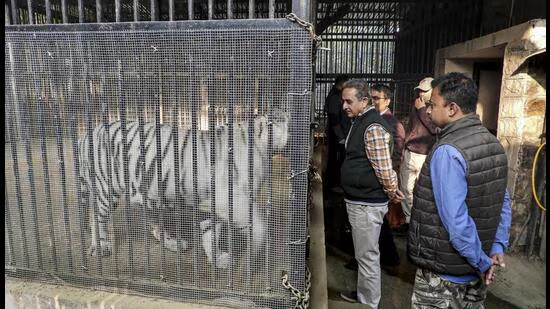
Durga stepped into the public arena this week, but not into a forest, not into a landscape shaped by monsoon and prey migration, not into a territory where a tiger builds a life. Instead, she appeared inside the failing confines of Delhi zoo, introduced with ceremony by Minister Kirtivardhan Singh, who proudly named her and her sibling as though this act carried the weight of real conservation. The event was celebrated as news, amplified as a story of care, and framed as a milestone for wildlife protection, as reported by Hindustan Times. But the truth remained unchanged: Durga is a white tiger bred for captivity, for display, for spectacle, not for survival or ecological purpose.
Singh’s visit was packaged as a review of conservation measures, though his schedule made the real priorities unmistakable. He moved from enclosure to enclosure, observing lions, elephants and even a hospitalised cub, before pausing for the moment of the day: naming two white tiger cubs Durga and Devi. That ceremony was treated as a gesture of leadership, as if conservation emerges from naming cages rather than safeguarding habitats. It played well for photographs, but photographs cannot hide the nature of white tiger breeding. White tigers are not a subspecies, not a conservation resource, not assets to India’s future. They are the product of deliberate inbreeding, produced by zoos because the public pays more to see them.
The Ritual Of Naming What Should Not Exist
Durga’s public launch mirrored the pattern that has plagued captive tiger programmes worldwide. A cub is given a powerful name to conceal an uncomfortable truth. In this case, Durga was introduced as a symbol of strength, despite being born from a lineage shaped by genetic narrowing and welfare compromise. Delhi zoo emphasised her lineage, celebrated the release of the cub into the visitor arena and promoted the birth as a win. But nothing about the practice contributes to tiger conservation beyond rhetoric.
White tigers do not strengthen wild populations. They cannot be released into any reserve. They do not help recover genetic diversity. Their presence in zoos misleads the public into believing that captive breeding supports conservation, while it actually diverts resources away from what tiger protection requires: land, prey, trained personnel and political courage. None of that was addressed during the minister’s tour.
A Zoo In Decline Becomes A Stage For Policy Theatre
Delhi zoo has spent years accumulating failures. Recent weeks alone saw four jackals escape through damaged fencing and a python die after two days of treatment. These issues did not appear in the official briefing. Singh instead focused his attention on naming ceremonies and general reviews. The disconnect between presentation and reality was unmistakable. Delhi zoo has long been criticised for poor welfare, inadequate infrastructure and limited transparency, yet the minister chose symbolism over accountability.
Durga’s debut was designed to shift attention away from systemic issues. The public is encouraged to admire her beauty, to appreciate the spectacle of her release into the display enclosure, to believe that the presence of a minister signals progress. But progress is not measured in names. It is measured in the habitat a tiger will never see, the genetic integrity it will never possess, and the wild life it will never live.
A Conservation Country Misrepresented By Its Zoo
India has a strong tiger conservation record built through decades of real work in reserves, corridors and community landscapes. None of that is represented inside Delhi zoo. Yet the minister’s performance risks creating exactly that false association. When leaders celebrate zoo births instead of acknowledging the structural crisis of captivity, they mislead the public about what tiger protection requires. They obscure the fact that breeding white tigers is not a contribution to protection but a continuation of a harmful industry that profits from deformity and spectacle.
Durga did not ask for her name or her role in this performance. She is a young animal who will grow into an adult with no forest to claim, no natural social structure to navigate and no chance of raising cubs in the wild. She is an exhibit, not a conservation triumph.
What India Should Celebrate Instead Of Durga
If political leaders want to champion tigers, they should focus on landscapes where protection is possible and meaningful. They should highlight frontline staff who prevent poaching, support corridors that maintain genetic flow and invest in coexistence strategies that reduce conflict. None of this requires standing beside a cage. None of it requires naming a cub bred for display. It requires honesty, resources, and the recognition that real tiger futures are decided in forests, not in zoos.
Durga’s debut should provoke discomfort, not celebration. It represents a system that confuses entertainment with conservation, policy with performance and captivity with care. The minister’s ceremony may produce photographs and headlines, but it will not produce a single tiger fit for the wild. Until India stops legitimising zoos as conservation centres, funding and focus will continue to drift away from the landscapes where real tigers still fight for survival. That is why this moment, despite its cheerful presentation, should remind us that genuine protection is built on long-term conservation practices, accessible through this internal link to broader field-based approaches.
Source: Hindustan Times, India.
Photo: Hindustan Times, India.