Core zone protection finally received legal force this week, as India’s Supreme Court issued strict guidelines banning tiger safaris and night tourism from the most sensitive parts of the country’s reserves. As reported by Times of India, the court ruled that safaris may operate only on degraded buffer land—not inside a core zone, not inside a corridor, and not anywhere tigers depend on silence and undisturbed movement. For the first time in years, the message is unambiguous: tiger habitat is not for sale.
A Core Zone Exists For Tigers Alone
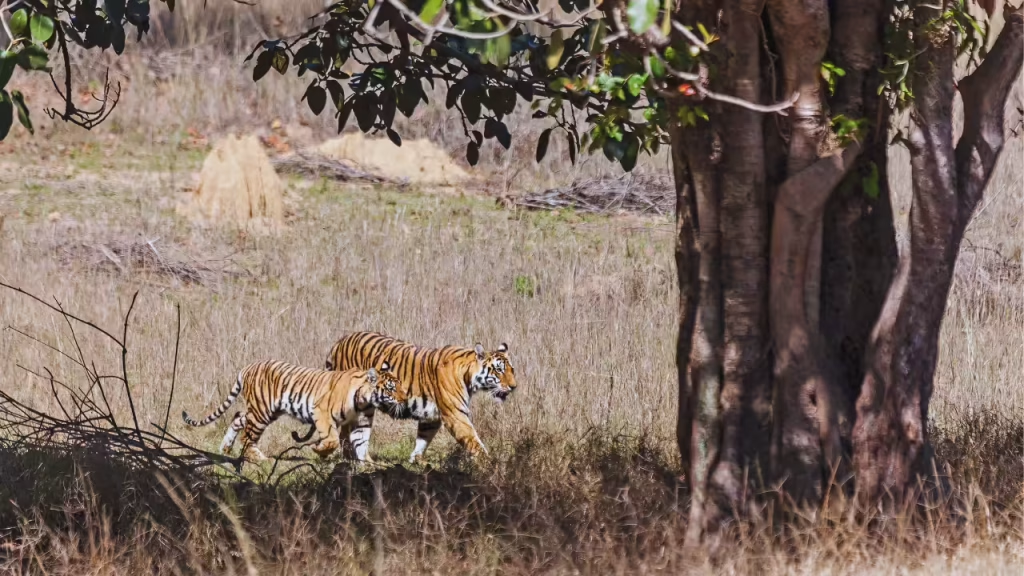
The ruling rejects the idea that tourism and wildlife protection can coexist inside a core zone. The court stated that this space must remain “inviolate,” meaning completely free from human pressure. Tigers do not negotiate disturbance. When noise enters, they retreat; when vehicles appear, they shift routes; when humans gather, they abandon behaviour essential for their survival. A core zone is the last functioning refuge many reserves have left.
The ban on night tourism supports this reality. Darkness is hunting time, cub-rearing time, movement time. Lights, engines and crowds erase it instantly. Emergency vehicles are the only exception. Everyone else must stay out.
This is the first step toward rebuilding what years of intrusive tourism and infrastructure have eroded: the ability of a tiger to live without human interruption.
Halting The Surrounding Pressures That Crush Tiger Space
The Supreme Court widened its protection beyond the core zone itself, blocking destructive activities around reserves. Mining, sawmills, hydroelectric projects, polluting factories, hazardous materials and exotic species introductions are all prohibited near tiger landscapes. These forces fragment habitat long before poaching or conflict appears.
The court also ordered state governments to notify Eco-Sensitive Zones within a year—a move that ends decades of delay, political bargaining and boundary manipulation. Without ESZs, a core zone becomes an island, surrounded by chaos with no buffer to absorb noise, construction or industrial expansion.
Tourism infrastructure was also addressed directly. New resorts are banned from corridors, and ecotourism must be “regulated, not mass.” The court emphasised small, community-led options in buffer areas rather than large commercial footprints that dominate forest edges and push wildlife deeper into shrinking terrain.
A Framework That Demands Action, Not Interpretation
State governments now have strict deadlines: three months to update Tiger Conservation Plans and six months to officially notify core and buffer areas. These timelines are essential because the biggest threat to tiger conservation is ambiguity. When states “reinterpret” boundaries, projects slip in. When enforcement is lax, vehicles enter. When definitions bend, a core zone becomes another marketing term.
Tigers pay for every blurred line with territory, prey access and safety. The court has now made those lines firm. A core zone cannot be reclassified for convenience.
This judgment resets the priorities. It says that ecological truth—not commercial pressure—sets the rules. A tiger cannot survive without uninterrupted ground, and uninterrupted ground requires absolute limits on human behaviour.
What This Means For The Future Of Wild Tigers
India holds most of the world’s remaining tigers, yet their landscapes are shrinking faster than their populations can adapt. A core zone is the only place where tigers can move without bumping into recreation, noise or human unpredictability. The Supreme Court ruling forces a return to that basic truth: if the core is intact, everything else becomes possible. If the core collapses, nothing else matters.
Tourism can survive in buffers. Communities can thrive in fringe zones. But the core zone must be left alone—not partially, not conditionally, not performatively. Fully alone.
The verdict does not undo past damage, but it prevents new harm. It forces states to choose between political convenience and living ecosystems. And it establishes a legal reality that should have existed 20 years ago: tiger reserves are for tigers first, humans second.
A core zone is not theory. It is not a marketing toy. It is survival architecture. When kept intact, it gives tigers territory, continuity and space to be wild. And that is the foundation of every meaningful conservation practice that stands a chance of keeping them alive for another generation.
Source: Times of India, India
Photo: Times of India, India