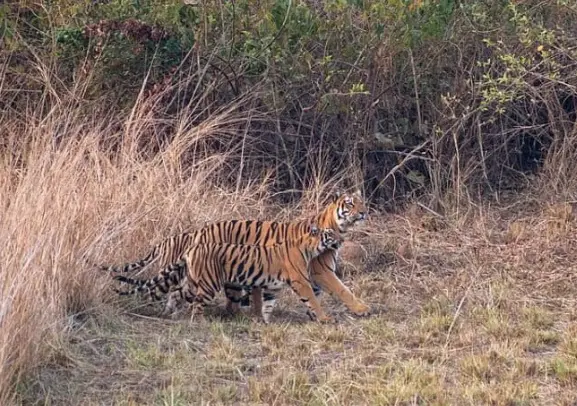
For a tiger, leaving home is not a choice—it’s survival. A new long-term study from Maharashtra’s Eastern Vidarbha Landscape reveals how young tigers disperse from their natal ranges into human-dominated terrain, adapting their pace and direction as they face the risks of roads, farms, and fences. The findings expose how India’s protected areas remain comfort zones, while everything beyond them is danger by design.
The research, published in Global Ecology and Conservation and reported by Mongabay India, tracked 15 subadult tigers over seven years using GPS collars. It mapped three critical stages of tiger development—pre-dispersal, dispersal, and post-dispersal—capturing how behaviour shifts from caution near the mother’s territory to speed and stealth through villages and farmland, then to measured stability in new home ranges.
Comfort zones
At first, tigers stayed close to their mothers, resting by day and travelling by night. This “comfort zone” period showed how dependent subadults are on forest cover and familiarity. Once they ventured beyond, the study found that their survival depended on speed and timing. Tigers moved slower in forests but accelerated through farms, minimising time spent in risky spaces. Their instinct was clear: avoid people, keep moving, and find cover before dawn.
Such behavioural intelligence should guide policy, yet it rarely does. As tigers left protected zones, their risk multiplied—not from natural predators but from electricity poles, open wells, and illegal fences. Several collared individuals died from electrocution. Instead of reforming these hazards, authorities treat them as accidents, not symptoms of systemic neglect.
The Eastern Vidarbha Landscape—covering Tadoba-Andhari, Umred-Karhandla, and Tipeshwar—hosts one-fifth of Maharashtra’s population and up to 500 tigers. Between these reserves lie over 8,500 villages, agricultural grids, and roads. These are not tiger corridors in practice, only in name. India’s conservation strategy still ends where human habitation begins.
From comfort zones to survival zones
The comfort zones of reserves like Tadoba are shrinking in ecological value because dispersal is unsafe. As the study shows, tigers speed through villages at dusk, crossing roads in minutes. That is not coexistence—it’s avoidance. When an animal must sprint through farmland to survive, it means humans have claimed every space that once allowed it to breathe.
Researchers used Hidden Markov Models to decode movement states—resting, travelling, foraging—and matched them with temperature, vegetation, and human density. They found tigers most active at 20–30°C, resting as temperatures soared above 40°C. Their movement patterns revealed a sophisticated response to pressure: travel at night, linger in forest pockets, cross farms fast. Yet management plans still operate on the outdated assumption that “conflict” occurs only when tigers attack. The study proves it begins the moment their comfort zone ends.
Habitat fragmentation is now the single biggest threat to India’s tigers. Over one-third live outside reserves, navigating fragmented landscapes with almost no formal protection. The conservation practices India celebrates—anti-poaching, tourism control, census counts—ignore the space between reserves where dispersing tigers die unseen.
Lessons for conservation managers
Researchers say this is the first study to track tigers across life stages, identifying precisely when they are most vulnerable. The takeaway is blunt: conservation must extend beyond park boundaries. Safe corridors are not “future goals” but present necessities. The smaller unprotected forests—often dismissed as “wastelands”—are lifelines for dispersing cats.
Kerala and Madhya Pradesh are building eco-bridges and fencing-free zones, but Maharashtra still lags. The state’s forest department issues press statements about rising tiger numbers while ignoring the rising electrocution count. Tigers leaving comfort zones are forced to test the limits of coexistence every day.
Coexistence cannot mean containment. Supporting villagers who share these frontlines—with timely compensation, solar fencing maintenance, and corridor restoration—would protect both people and tigers. The study’s lead author, Pallavi Ghaskadbi, notes that understanding behaviour “from comfort zone to independence” can prevent conflict before it erupts.
India’s tiger success story has always been told through census numbers. This research reminds us that real success lies between the reserves—in how a young tiger crosses human territory and still lives to establish its own. Unless corridor safety becomes as central as population counts, “Project Tiger” risks becoming an archive of what was once possible.
Source: Mongabay India
Photo: Mongabay India