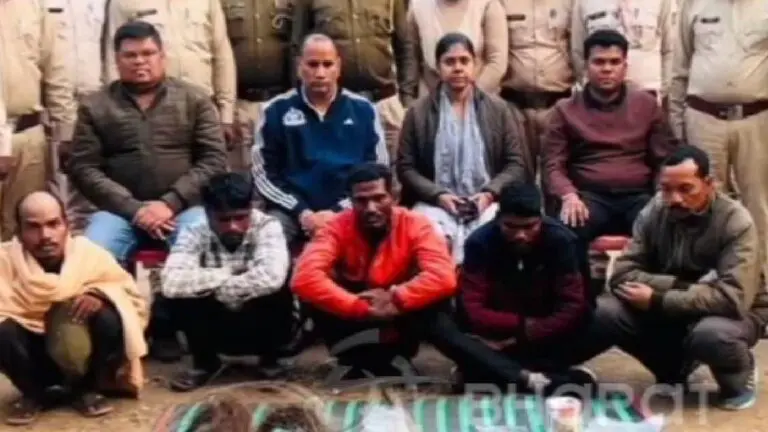
Biswanath has again revealed the violent undercurrent of India’s wildlife crime networks, as reported by Guhawati Plus News, after officials recovered the bones of a Royal Bengal tiger from a group attempting to sell them for profit. Five men were detained during the operation, which involved teams from the Eastern Range, Gamaria, and the Crime Investigation Range of the Biswanath Wildlife Division. The arrests should have triggered national outrage, yet the country’s weak punishment system continues to protect poachers and traders more than the endangered wildlife they destroy. For tigers already fighting against shrinking habitats, every carcass stolen from the landscape is another blow made heavier by legal systems that refuse to take their deaths seriously.
A Tiger Torn Apart For Profit, And A District Forced To Watch
Authorities found the tiger bones in possession of a man from Simaluguri Baligaon in the Gohpur area. Investigators believe the group had links to individuals previously involved in rhino poaching, suggesting the same criminal pipelines now traffic tiger parts with the same ease. Biswanath sits in a sensitive zone under Kaziranga Tiger Reserve, where forest patches and riverine corridors allow tigers to move between ranges. When a tiger is killed here, the impact radiates across the entire population structure. Each poaching incident collapses genetic strength and destabilises territories, and yet the legal response rarely reflects the scale of the damage.
Today, five individuals face charges that historically lead to jail terms far too short to act as deterrents. For endangered wildlife, such penalties are a mockery, particularly when the market for bones extends beyond India’s borders. Tigers do not die by accident in these networks; they are hunted deliberately, their organs trafficked through routes well-known to authorities. Yet prosecution remains slow, conviction rates remain low, and even the harshest sentences stop short of the life imprisonment that should accompany the killing of an endangered species.
Why Biswanath Again Shows That India’s Laws Protect Poachers
Despite improvements in patrolling and intelligence gathering, enforcement collapses whenever the judicial pipeline begins. Cases languish for years, and the accused often secure bail within days. In landscapes like Biswanath, where Kaziranga’s tigers depend on human discipline to survive, the message is clear: poaching carries risk, but not enough to outweigh profit. India’s wildlife laws treat killing a tiger as a forest offence, not an act of ecological sabotage. Until this changes, poachers will continue to operate with confidence, knowing that even conviction will not remove them permanently from the landscape.
Communities living near protected areas see the consequences. When people involved in wildlife crime return after short sentences, enforcement loses credibility, and fear replaces trust. A single tiger killing in Biswanath does not stop at one death; it ripples outward, pushing surviving tigers into unstable territories where conflict becomes more likely. Villagers then suffer losses, and governments blame the tiger rather than the criminals who dismantled the balance in the first place.
Tigers Cannot Survive When The Law Is Designed To Forgive
In a district where tigers disperse across riverbanks, tea estates, and forest fragments, poaching is not simply a crime—it is a targeted attack on the region’s ecological future. Biswanath’s recovery depends on punishments that match the seriousness of killing a tiger. Life imprisonment must be the baseline for anyone who hunts, traps or trades in endangered species, whether intentionally or by reckless action. Anything less treats tiger lives as disposable and emboldens networks that operate like organised crime syndicates.
India’s lawmakers often claim that existing provisions under the Wildlife Protection Act are strong enough. But strength without enforcement is a hollow promise. Real deterrence requires punishment severe enough to make the trade unthinkable. When a forest department seizes tiger bones, it has already failed to protect the tiger. Allowing the perpetrators to walk free after serving short sentences only ensures the next carcass is already on its way.
Biswanath’s tragedy reflects a broader pattern documented in analyses of persistent tiger deaths and the systemic failures that follow each one.
Here, another tiger has been reduced to bones, another criminal chain exposed, and another opportunity arises for India to decide whether it wants living tigers or endless excuses. The law must choose life for tigers by choosing life imprisonment for those who kill them.
Source: Guwahati Plus, India
Photo: Guwahati Plus, India