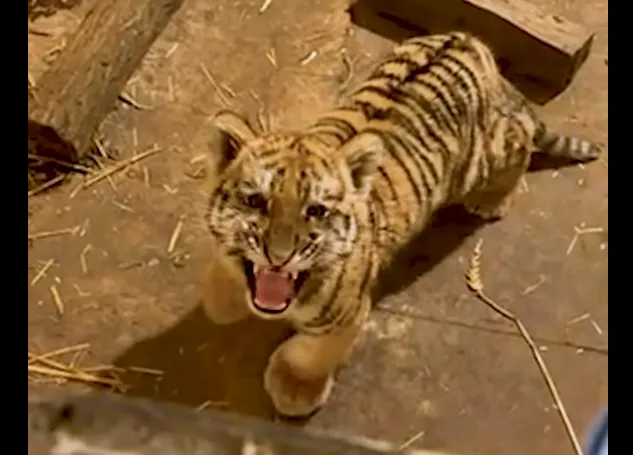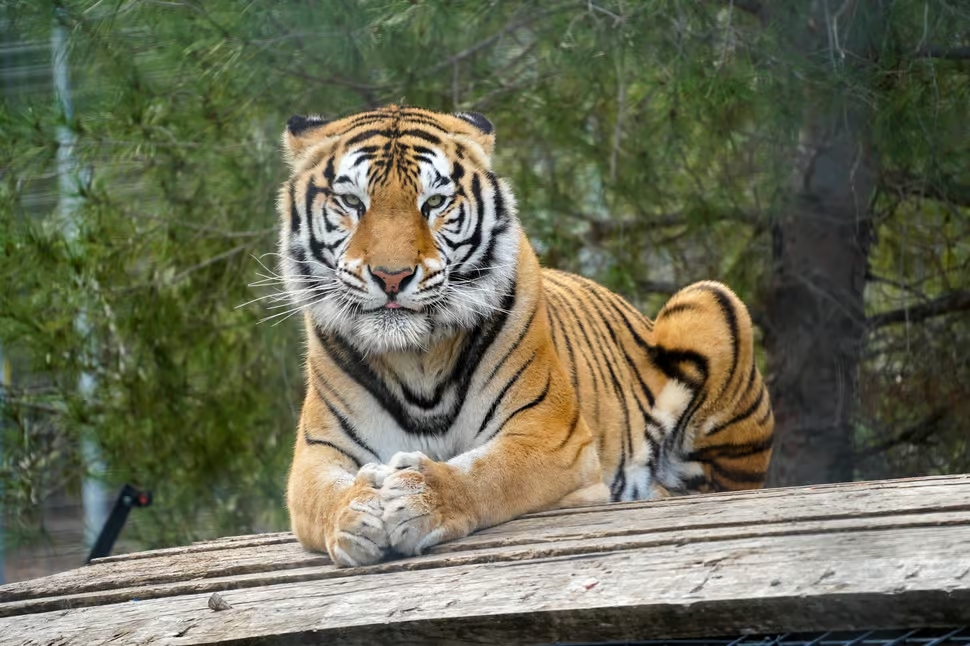
Aqua did not come from a jungle. He came from a truck — one packed with trafficked tigers seized at the Poland–Belarus border in 2019. He survived dehydration, stress, confinement, and the brutal anonymity of illegal wildlife transport. He lived only because authorities intervened and specialists stepped in to stop a chain that often ends in either slaughter or black-market “exotic pet” ownership.
After the seizure, Aqua was moved to AAP’s rehabilitation centre in Spain. There, he spent years recovering in privacy, regaining strength, learning to trust safety, and existing without human spectators. It was not wilderness — but it was quiet, calm, and built for healing instead of display.
Now Aqua lives at a zoo in England.
His arrival at Noah’s Ark Zoo Farm near Bristol was reported by Bristol World with warm language: a “forever home,” a new chapter, a celebration of care. It was presented like a rescue fairy tale. But survival inside a public exhibit is not freedom. Aqua has moved from cruelty to comfort — but not to autonomy. A tiger who escapes a trafficker’s cage only to live behind viewing glass has not been returned to life; he has simply been transferred into a more polished enclosure.
Aqua is alive, and alive matters. But life without sovereignty is not recovery. It is captivity, softened by landscaping and kind intentions.
Rescue Without Choice Is Still Captivity
In Spain, Aqua’s world was built for rehabilitation. His privacy mattered. Human contact was limited. He had space not to be seen — to exist without being a lesson or an attraction. That is dignity, even inside rescue.
In Bristol, everything changes. His space now exists for the public too. Visitors, viewing platforms, and interpretive signs become part of his daily reality. His behaviours — swimming, pacing, climbing — will be visible by design. The zoo will describe this as education and conservation. But education built on captivity is still captivity. Conservation that depends on display is not conservation — it is theatre.
Aqua did not choose this life. And he cannot choose anything now. Not territory. Not solitude. Not when or how he appears. Captivity removes decision. It replaces wild agency with structured enrichment, routine, and human control.
A zoo can be humane. It cannot be freedom.
The Kindness Narrative Masks Control
Project Carnivora, the zoo’s carnivore expansion program, highlights more space, better viewing, improved enrichment. Pools, climbing structures, feeding poles — all engineered to look natural while serving a dual purpose: animal welfare and visitor experience.
Modern zoos specialise in comfort optics. Smooth paths. Green backdrops. Glass that pretends to disappear. But an enclosure, no matter how generous, is still a system of control. The public sees beauty. The tiger sees perimeter.
Even the language has evolved. The cruelty of old cages has been replaced with wellness rhetoric — “enrichment,” “mental stimulation,” “natural behaviours.” But natural behaviour without natural choice is imitation. A tiger leaping for food hung on a pole is not hunting — it is performing survival inside constraint.
This soft captivity model — where compassion hides confinement — mirrors broader ethical concerns about the hidden cruelty in modern captivity systems that keep animals safe while denying them the one thing humans can’t replicate: wild self-determinism.
A Life Safe, But Never Wild Again
Some will argue Aqua could never be released; his wilderness was stolen before he ever touched soil. That is true. But the impossibility of release does not turn captivity into triumph. It only exposes the failure that preceded it: the world that let trafficking happen and habitat disappear long before Aqua reached Europe.
He will never scent-mark a forest ridge, never stalk prey across grasslands, never choose where to sleep or patrol or rest. He will never exist beyond human design again. His life will be predictable, safe, observed, and limited.
And yes, he will receive care. Zoo staff will feed him, vet him, enrich his days, speak softly, and protect him from harm. Their effort is sincere. Compassion does not erase captivity — it only softens it.
The public will feel inspired. But inspiration is not impact. A child staring at a tiger does not protect tigers. Policy, habitat, enforcement, indigenous stewardship, and political will protect tigers.
Aqua will inspire hearts. He will not shape landscapes.
A Tiger Saved From Abuse Should Not Become A Display
Aqua deserved silence, not spectators. His survival is a victory over a trafficker — not a validation of a zoo business model. Sanctuary should not end in permanent viewing. Rescue should not feed ticket sales. A tiger’s recovery should not be measured in visitor experiences.
The world cannot call itself successful if the only safe place for rescued tigers is another enclosure, another fence, another audience. True success is a world where fewer tigers need saving — not where rescued tigers become living exhibits of our guilt and good intentions.
Aqua escaped brutality. He now lives in containment shaped to feel gentle.
A tiger behind bars is captivity.
A tiger behind glass is still captivity.
A tiger admired does not equal a tiger free.
Aqua’s journey is not a fairy tale. It is a mirror held to us:
We didn’t return him to life. We returned him to a nicer cage.
Source: Bristol World, UK
Photo: Bristol World, UK