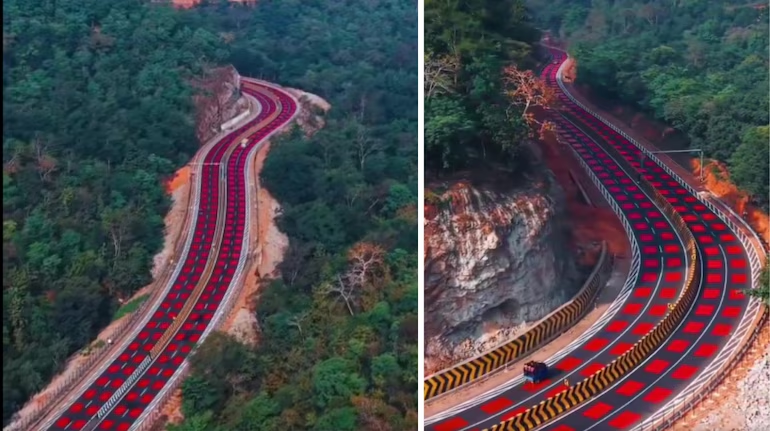
A wildlife-safe highway has been introduced on a key forest stretch in central India, marking a rare moment where road design explicitly acknowledges animal movement rather than treating it as collateral damage. The wildlife-safe highway initiative has been launched on National Highway 45 in Madhya Pradesh, cutting through a forest corridor that links the Nauradehi Wildlife Sanctuary and the Veerangana Durgavati Tiger Reserve, as reported by Moneycontrol. The project is being described as India’s first road designed specifically to reduce wildlife-vehicle collisions through visible, physical deterrents.
The intervention includes table-top red road markings designed to force vehicles to slow down as they pass through ecologically sensitive zones. Unlike painted warnings that drivers routinely ignore, these raised markings create vibration and discomfort at higher speeds, making speed reduction unavoidable rather than voluntary. The design is paired with existing underpasses intended to allow animals to cross beneath the road without entering traffic.
A Corridor Long Treated As Sacrifice Zone
The stretch of NH-45 runs through one of Madhya Pradesh’s most biologically important forest corridors. Tigers, leopards, deer, and other species use this landscape to move between protected areas, maintaining genetic flow that is essential for long-term survival. For decades, such corridors have been treated as expendable, sliced apart by roads built for speed and freight efficiency.
In that context, labeling this stretch a wildlife-safe highway represents a shift in framing, even if limited. The road has not been removed or rerouted. Instead, mitigation has been layered onto existing infrastructure, acknowledging that the animals were there first and that unrestricted speed through tiger habitat carries measurable consequences.
India has one of the highest rates of wildlife mortality from road and rail traffic globally. Tigers, despite their protected status, are routinely killed on highways that cut through reserves and buffer zones. These deaths are rarely framed as infrastructure failures. They are described as accidents, despite being entirely predictable outcomes of road placement and design.
The NH-45 intervention implicitly challenges that narrative. By altering road texture and forcing speed reduction, it accepts that driver behavior cannot be relied upon where enforcement is weak and consequences are delayed.
Design Over Declarations
Officials have described the project as a model for future wildlife-friendly infrastructure. The emphasis on physical design is significant. Speed limit signs and awareness campaigns have repeatedly failed to prevent collisions because they depend on compliance. A wildlife-safe highway, if taken seriously, removes discretion from drivers moving through animal habitat.
The table-top red markings are visually striking, deliberately breaking the monotony of asphalt that encourages high speeds. Their placement inside a tiger reserve is a reminder that this is not ordinary road space. It is contested territory where human movement intersects directly with animal survival.
However, the scale of the intervention remains narrow. One modified stretch does not offset thousands of kilometers of highways that continue to fragment forests across India. New road projects are still approved through critical habitats with minimal mitigation, often after clearance processes that prioritize economic timelines over ecological continuity.
The danger lies in celebrating isolated fixes while continuing business as usual elsewhere. A wildlife-safe highway cannot become a branding exercise that masks ongoing damage.
What Success Would Actually Mean
For this project to matter, its effectiveness must be measured honestly. Reduced collision data, sustained enforcement, and expansion to other corridors will determine whether this is a turning point or a public relations milestone. If animal deaths continue nearby, the label alone means nothing.
There is also the question of replication. Wildlife corridors exist across India, many already severed by roads and railways. Applying similar designs selectively while approving new high-speed corridors through forests sends a contradictory message. Infrastructure cannot be wildlife-safe in fragments.
Still, the NH-45 project introduces an important precedent. It acknowledges that roads are not neutral and that design choices directly influence mortality. In a country where tigers are killed by vehicles with numbing regularity, that acknowledgment matters.
If India is serious about reducing wildlife deaths, mitigation must become mandatory, not optional, and retrofitting existing roads must be treated as urgent, not experimental. The consequences of delay are measured in bodies on asphalt.
The long record of tiger deaths on roads and railways shows what happens when speed and connectivity are prioritized without restraint, a reality documented repeatedly in examinations of road and train strikes and their fatal impact on tigers. Whether the wildlife-safe highway on NH-45 becomes an exception or the beginning of a structural shift will define how seriously India values coexistence over convenience.
Source: Moneycontrol, India
Photo: Moneycontrol, India