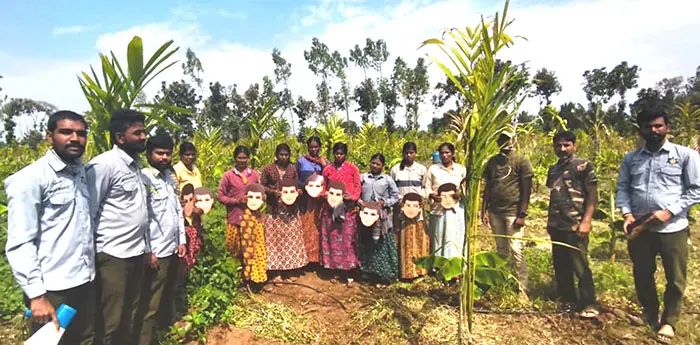
Masks have returned to the edge of Bandipur, this time not for disease but as a tool against tiger attacks. In villages across Saragur taluk, forest officials are distributing thousands of human-face masks designed to be worn on the back of the head, a practice borrowed from the Sundarbans and framed as a protective measure against ambush. The idea is rooted in a known behavioural pattern: tigers prefer to strike from behind, avoiding direct eye contact. But this new campaign exposes something more troubling than risk. It shows how fragile, stopgap thinking has replaced long-term strategy in Karnataka’s most contested human–tiger landscape, a place that urgently needs planning, not props.
This crisis of masks makes sense only when placed beside broader truths about coexistence, many of which are already evident in the principles of conservation practice explained through long-standing methods in conservation practice.
A Simple Mask For A Complex Problem
The Forest Department describes the masks as an awareness tool meant to reduce surprise encounters. They claim that when a tiger sees what looks like a human face watching it, the likelihood of an attack decreases. But the incidents in Saragur taluk are not accidents born from inattentiveness; they are consequences of degraded edges, rising snare injuries, shrinking buffers and years of weak early-warning systems. Presenting masks as protection gives people the illusion that tigers are simple to outsmart. They are not. A mask on the back of the head cannot compensate for failed patrols, abandoned wells, neglected prey management and a conflict-response chain that activates only after tragedy.
To their credit, local staff are visiting every settlement and explaining how to wear the masks. They travel from hamlet to hamlet, demonstrating technique with sincerity. Yet this sincerity cannot mask the deeper truth: human–tiger conflict stems from structural neglect, not vision tricks. Tigers pushed out of core zones by injury or scarcity are responding to survival, not deception. Knowing this, governments still choose spectacle over science.
The False Promise Of Safety
In the Sundarbans, the back-facing mask experiment worked only under specific conditions: mangrove terrain, predictable tiger movement and an entirely different social dynamic of forest entry. Even there, it was never a substitute for proper management. Bandipur’s terrain is open dry forest, with cattle movement, fragmented fields and roads slicing through dispersal routes. When officials present masks as solutions, residents may believe their risk has dropped when, in reality, nothing ecological has changed.
This disconnect becomes sharp when compared with the three deaths reported recently in Saragur. Each incident followed a familiar pattern: a wounded or displaced tiger, a delayed alert, a rushed response and a call for capture. Using masks does nothing to address this pattern. Instead, it slows the demands for real change. A tiger avoiding eye contact is a behavioural insight; thinking it can be tricked into abandoning instinct is a dangerous oversimplification. The wild is not a classroom experiment, and a conflict zone is not a stage for improvisation.
The Real Threat Lies Behind The Masks
Behind every new safety campaign lies an unspoken admission: early-warning systems remain weak. Remote-sensing technology, AI-assisted tracking and community-based monitoring exist, but investment remains slow. Snares still maim dispersing tigers. Grazing still pushes deep into buffer zones. Villages still receive late alerts. Meanwhile, the state keeps repeating cycles of capture and confinement, sending injured animals to centres far from the forests they once regulated. The pressure to calm voters grows stronger than the obligation to fix systems.
According to reporting from Star of Mysore, the department has distributed 10,000 masks. This volume alone signals desperation. When authorities distribute thousands of cardboard solutions, it means they are turning away from infrastructure that should already exist: automated warning sirens, perimeter sensors, compensation that actually arrives and trained rapid-response teams.
What Coexistence Actually Requires
Masks cannot create coexistence. They cannot restore prey populations, secure boundaries, repair wells or remove snares. They cannot rebuild trust in a department that alternates between neglect and overreaction. True coexistence demands planning shaped by science and local insight: monitoring corridors, regulating land use, protecting cattle, reinforcing communication networks and ensuring that every conflict response is timely and proportionate. Without these, masks are performance.
Farmers deserve better than cardboard reassurance. They deserve functioning systems that prevent conflict before it begins. And tigers deserve landscapes where their movement is expected, monitored and protected—not vilified or boxed into predictable human fears. Coexistence has always been a test of government priorities, not community imagination.
A Pattern Karnataka Must Not Normalise
The hope invested in masks reflects a deeper cultural fatigue, where people are asked to protect themselves instead of being protected. Bandipur and its surroundings are among India’s most pressured tiger territories, and they reveal how political convenience often overrides ecological necessity. When officials champion visual tricks over structural repair, conflict becomes more frequent, not less. Each injury or death hardens attitudes and pushes officials further toward capture orders—a cycle that sacrifices both human safety and tiger futures.
Until Karnataka replaces symbolism with honest, disciplined planning, the forests around Bandipur will remain zones of preventable tension. Masks may face backward, but governance must face forward. Coexistence cannot survive on illusion. It survives only on systems strong enough to make the wild predictable again.
Source: Star of Mysore, India.
Photo: Star of Mysore, India.