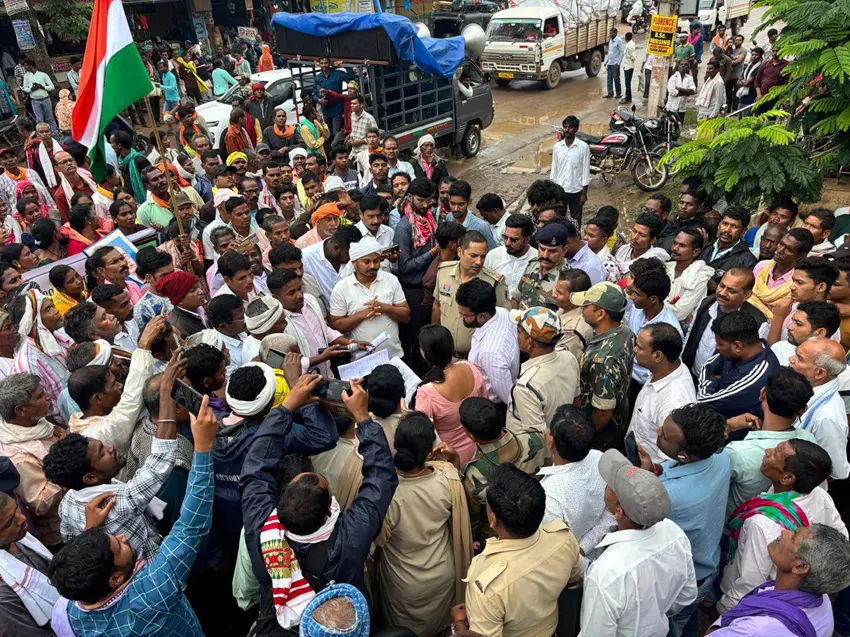
The Udanti-Sitanadi landscape in Chhattisgarh has become the centre of a deepening conflict where the rights of forest communities collide with the urgent need to protect a tiger population on the edge of disappearance. In the villages surrounding the Udanti-Sitanadi Tiger Reserve, public meetings have turned into crisis forums as residents fear the surveys and land markings conducted by forest officials signal an impending relocation, as reported by Mongabay India. The fear is understandable, yet so is the need for decisive conservation action: tigers are endangered, and their future depends on choices far more difficult than many community leaders admit.
Udanti-Sitanadi: A Landscape Of Surveys, Uncertainty And Strategic Resistance
The recent mapping exercises are not happening in isolation. They follow two decades of tension between the Forest Department and communities living inside the reserve. Residents accuse officials of restricting their access to forest resources and filing false cases to weaken their legal standing. Conservationists, however, note that these conflicts arise partly because the area was notified as a tiger reserve in 2009 while rights recognition remained incomplete.
Several villagers claim they coexist with tigers and should therefore stay. But coexistence is not a slogan; it is a scientific reality that requires stable prey, intact cover and minimal human disturbance. Adivasi culture includes traditions that respect wildlife, yet respect alone does not guarantee safe coexistence with an apex predator. Many claims of harmony are not supported by evidence and often emerge when relocation discussions loom. Such claims, while understandable, risk undermining the urgent action needed to prevent tiger extinction, like in Udanti-Sitanadi. At the same time, eviction must follow the law, and communities have the right to be fully informed, involved and compensated.
The region’s complicated history shows that effective conservation requires trust. Where communities are genuinely included, progress can occur, reflected in models where community engagement keeps tigers alive. But when participation is replaced with suspicion, even well-intentioned measures become fuel for conflict.
A Returning Tiger Sparks Old Fears And New Demands
After years of decline, camera traps recently captured new signs of a tiger in Udanti-Sitanadi. Earlier surveys showed six to eight tigers in 2006, dropping to one by 2018, and none in 2022. The recent sighting should have been celebrated as a milestone. Instead, it triggered more fear among villagers who believed relocation preparations were accelerating.
Spanning 1,842 square kilometres, the Udanti-Sitanadi reserve holds dense sal, teak and bamboo forests, along with the Udanti and Sitanadi rivers. This habitat offers real potential for tiger recovery—but only if protected properly. Tigers require large, undisturbed territories. Where human presence fills core habitat, breeding collapses. Where agriculture expands inside forests, prey disappears. Where settlements grow, conflict and retaliation follow. As tigers approach the brink of local extinction, the question becomes unavoidable: what should India prioritise—ancestral access or the survival of a species on the edge?
Legal Rights And Legal Violations
Community organisations have accused the reserve administration of violating the Forest Rights Act by rejecting claims without proper procedure and misusing satellite imagery to argue that settlements expanded after 2009. Some families from Sornamal, Ichhradi and Dashpur have already been removed without full compliance, according to community testimonies. If true, these actions breach both legal protections and basic human dignity.
Yet authorities counter that many settlements are not traditional but were created through recent encroachments, some by outsiders seeking farmland. The reserve deputy director says illegal clearances covered nearly 200 hectares and that several encroachers were removed lawfully. Two villages, officials say, have already agreed to relocate voluntarily.
The Ministry of Tribal Affairs has demanded clarification, emphasising that no relocation can occur without Gram Sabha consent. This intervention highlights the complexity of distinguishing genuine rights from strategic claims used to block conservation. The process must be transparent, but transparency cannot be used to delay action indefinitely.
A Future Decided By Human Choices, Not Silence
Adivasi communities have a long relationship with the forest, and their cultural identity deserves protection. But tigers too have a claim to survival, and unlike humans, they have no alternatives. Tigers cannot negotiate, relocate on their own terms or defend their legal rights. Their disappearance is permanent.
If tiger recovery in Udanti-Sitanadi is truly a national priority, humans will need to make sacrifices—fairly negotiated, legally grounded and ethically implemented, but sacrifices nonetheless. Conservation that avoids difficult decisions only delays collapse.
The future of Udanti-Sitanadi depends on finding the rare balance where rights are honoured and extinction is prevented. Without bold action guided by law and science, this reserve will lose its tigers forever.
Source: Mongabay India, India.
Photo: Mongabay India, India.