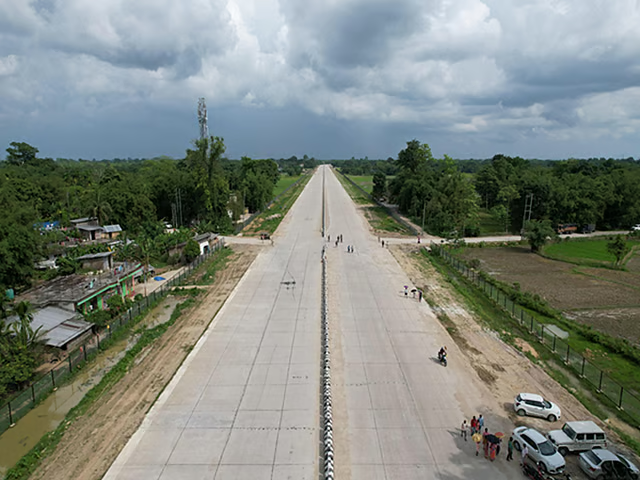
The Karnataka Wildlife Board has approved construction of the Kushalanagar–Mysuru highway, a 100-kilometre project by the National Highways Authority of India. It will cut through the eco-sensitive zone of Ranganthittu Bird Sanctuary and the buffer of Nagarhole Tiger Reserve. Behind bureaucratic language about “development,” the decision represents one more deliberate retreat from ecological truth.
Officials said the project, divided into four phases, will “improve connectivity.” But connectivity for whom? The same roads that connect humans disconnect ecosystems. The Kushalanagar–Mysuru highway demands 54 hectares of forest land—a small patch on paper, yet a crucial link in one of southern India’s richest wildlife corridors. Once cut, no corridor heals.
The approval, as reported by The New Indian Express, came swiftly. Meetings lasted hours; damage will last generations.
Development as disguise
The board also cleared a separate road-widening project through the Sharavathi Lion-Tailed Macaque Sanctuary, another fragile pocket of biodiversity. Officials claim it will “benefit dwellers inside the patch,” a line repeated in almost every clearance. Yet, as the forest opens, settlements expand, trucks enter, and the silence that defines sanctuaries turns mechanical.
Each new road sparks the same choreography: proposals, clearances, committee visits, and eventual construction. The result is predictable. Roads bring fragmentation, noise, light, and waste—each one eroding the instinctive paths tigers follow to survive. The Kushalanagar–Mysuru highway is not an engineering plan; it is a slow-motion eviction order for wildlife.
Across India, infrastructure has replaced foresight. Environmental committees now serve as corridors for paperwork, not for animals. The process is procedural theatre, where ministries perform protection while signing its undoing.
The corridor that keeps India alive
Nagarhole, part of India’s Western Ghats landscape, depends on connected forests to sustain its tigers and elephants. Corridors allow genetic exchange and ecological renewal—lifelines that hold the population together. Destroying one section isolates the rest. The state’s argument that “existing highways haven’t impeded movement” ignores that wildlife doesn’t speak through surveys. Dead animals on roads are the real reports.
The decision mirrors long-running patterns of political failure and corruption that dominate India’s environmental governance. Leaders praise tiger numbers while financing the projects that chip away at their last habitats. Calling this balance is deception, not nuance.
India’s own National Tiger Conservation Authority once warned that roads through buffer zones weaken meta-populations. But institutional memory fades fast when budgets rise. Political leaders celebrate the Kushalanagar–Mysuru highway as progress, even as the word “corridor” quietly disappears from public documents.
Progress without memory
Forest Minister Eshwar Khandre chaired the board meeting that cleared the project. He promised further review by the National Board for Wildlife, though the outcome is already predictable. Less than two percent of such projects ever face rejection. Approval has become ritual; scrutiny, formality.
The minister said the project “will enhance livelihoods.” In truth, it enhances convenience—for freight, for tourism, for votes. Livelihoods built on deforestation last a generation; ecosystems that die take centuries to return. The Kushalanagar–Mysuru highway will feed traffic, not families.
Meanwhile, forest guards, scientists, and local activists will keep counting carcasses on the side of new asphalt. They know this is not development but inheritance theft—the taking of the only wealth India cannot rebuild once lost.
A question of intent
When governments frame destruction as necessity, the failure is not technical—it’s moral. Karnataka’s approval joins a long list of decisions proving that environmental governance functions like a relay race of denial. Each signature passes responsibility to the next.
The tiger’s survival depends on connected terrain, but the state’s agenda depends on connected highways. Every map of the Kushalanagar–Mysuru highway tells the same story: a straight human line through a living system that was never meant to be linear.
Real progress would mean halting this pattern—funding coexistence, not concrete. Yet until that happens, India will keep trading forests for roads and calling it growth. For the tiger, there is no such trade. Every clearance is another border drawn against life. And when the Kushalanagar–Mysuru highway finally opens, its smooth surface will hide the rough truth: a government that chose speed over sense, and a society that measured progress in minutes saved instead of lives and landscapes protected. Not by the tigers.