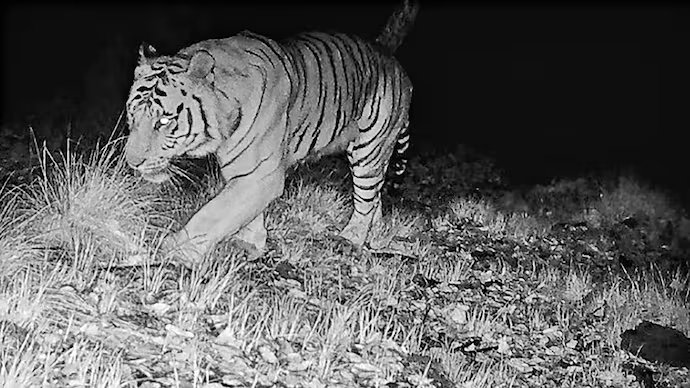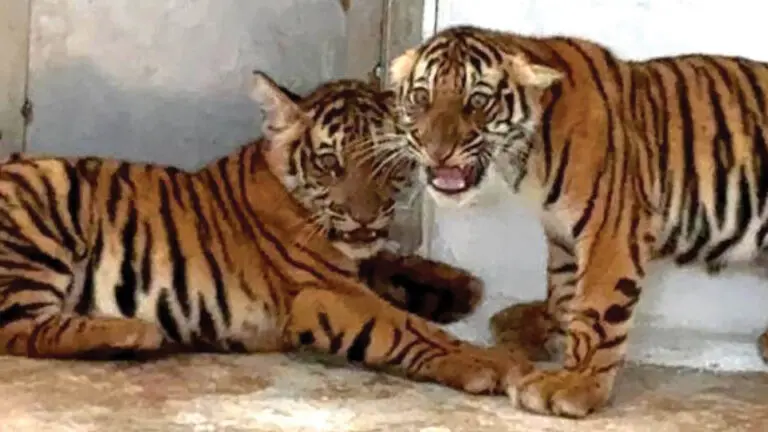
Two of the three tiger cubs rescued from the BRT Tiger Reserve are dead. The third, a fragile female, now lies under constant watch at the Bannerughatta Rescue and Rehabilitation Centre in Bengaluru. Forest officers said the cubs were deserted by their mother soon after birth and were too weak to survive without her milk and colostrum. The story, reported by Times of India, is one of compassion and helplessness woven together — a glimpse of how the wild loses its strength when human hands try to stand in for nature.
The cubs were found near Punajanuru-Bedaguli Road in October, within Karnataka’s BRT Tiger Reserve. Attempts to reunite them with their mother failed. As per the National Tiger Conservation Authority’s (NTCA) rules, they were shifted first to the Mysuru rescue facility, then to Bannerughatta after two died. The lone survivor now lives in a sterile world of gloves, drips, and measured feeding, while her species’ natural rhythms fade behind medical care.
The paradox of rescue
The Bannerughatta Rescue Centre embodies both success and surrender. It rescues what can no longer return home. The staff do extraordinary work — veterinarians monitoring, feeding, hydrating, and stabilizing — yet every healed animal represents a broken ecosystem. The cub’s life depends on the same human machinery that destroyed its mother’s safety net. Conservation in India is often forced into triage mode, fighting consequences rather than causes.
Facilities like Bannerughatta are the last stop for too many animals — injured leopards, orphaned elephants, poisoned tigers. Their names change, their conditions differ, but their stories remain the same: survival detached from wilderness. As examined in conservation practices, rescue without habitat repair becomes a revolving door — one tiger saved, another displaced, the wild shrinking in the background.
When nature stops trusting
The forest department tried to reunite the cubs with their mother, but she never returned. Perhaps she was dead, or too frightened by human presence. Either way, her absence exposes the growing tension at the edge of India’s reserves. Even protected zones are now ringed by roads, farms, and villages. Every noise, light, and scent from outside alters the rhythm of the wild. When tigers stop trusting their forest, they stop returning to their cubs.
Bannerughatta now stands as the symbol of that fracture. It is both sanctuary and reminder — a place where we keep what we’ve taken from the wild and try to call it mercy. The surviving cub’s life will depend on round-the-clock supervision. If she grows strong, she may live decades behind fences, safe but never free. That is not rescue; it is preservation in captivity.
The human comfort of care
Society applauds rescues like the At Bannerughatta rescue in Karnataka, one tiger cub survives while two perish — a story of compassion that reveals the fragile edge of conservation.
because they offer relief — evidence that humans can fix what humans broke. Yet this comfort hides a painful truth: no amount of medical care can replace the maternal bond or the lessons of the wild. A tiger raised by people never learns to hunt, defend, or disappear. It becomes dependent, an eternal child of human guardianship.
The irony is that India excels at rescue and rehabilitation but struggles with prevention. They know how to sedate, transport, and feed. They rarely manage to leave nature intact. Every successful operation at Bannerughatta Rescue is a small act of grace and a loud admission of failure — proof that coexistence has been replaced by crisis management.
Beyond sympathy
If India wants fewer tiger rescues, it must first accept that not every tiger needs saving. What they need is space, prey, and quiet. The cub at Bannerughatta will live, but her forest has already died around her. And unless the nation protects that forest with the same urgency it gives to press releases and photos of rescue trucks, she will not be the last orphaned tiger to arrive.
The Bannerughatta Rescue is a miracle built on loss — a place that keeps the wild alive by reminding us that it no longer is.
Source: Times of India, India
Photo: Times of India, India