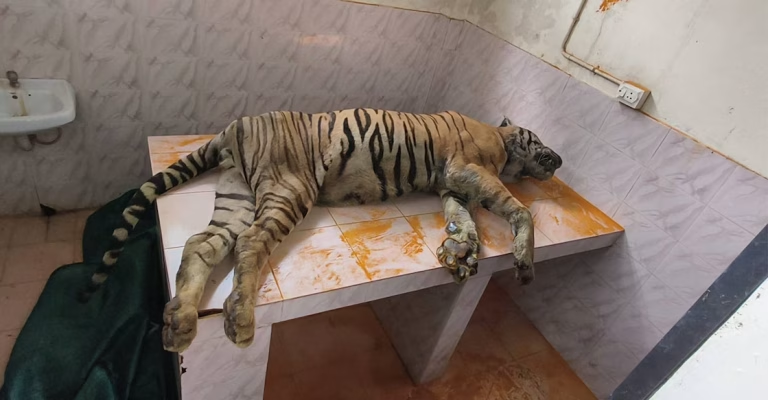
Three large cats — an Amur tiger, a clouded leopard, and a cheetah — were recently sedated and examined at The Big Cat Sanctuary in Kent, their bodies slid into a mobile CT scan unit to diagnose unexplained “mobility issues.” The image, circulated by press and public relations teams, shows Luca the tiger with his paws outstretched, eyes closed, surrounded by machines meant for human medicine. The story, first reported by The Independent, was framed as an inspiring act of collaboration — modern technology in service of animal welfare. But behind that clinical scene lies a contradiction: when confinement itself is the disease, there is no scan that can heal it.
The medical miracle narrative
The language of progress is seductive. The sanctuary’s curators and veterinarians describe the CT scan day as “a brilliant demonstration of collaborative animal welfare,” and in procedural terms, it was. Vets from the International Zoo Veterinary Group sedated each animal, ran imaging diagnostics, and promised careful monitoring during recovery. Their compassion is real, their expertise undisputed. Yet, the deeper truth is that their intervention exists because the system itself — captivity — produces the conditions for such suffering.
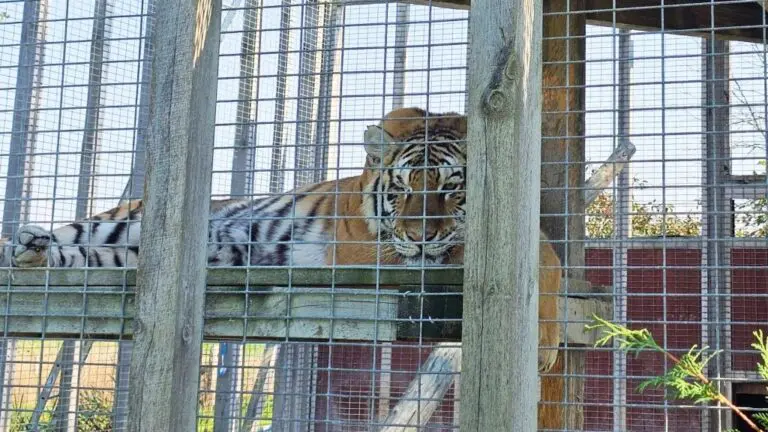
The animals were not injured in the wild, ambushed by snares or shot by poachers. They became immobile within controlled habitats built to protect them. Artificial terrain, repetitive pacing, restricted genetics, and the absence of choice all shape bodies that are strong but purposeless. The CT scan becomes not just a diagnostic tool but a symbol of how modern captivity converts care into spectacle: an act of compassion framed inside the very architecture of control.
Technology as anesthesia for conscience
Each CT scan offers a high-resolution view of muscle, bone, and tissue, but not of cause. It can detect a lesion but not the psychology of confinement. It can map the spine but not the absence of horizon. What such procedures often mask is society’s unease with captivity itself. High-tech care reassures the public that these animals are “looked after.” Yet, as these institutions have shown again and again, medicalization of captivity does not equate to welfare — it is often a way to postpone moral reckoning.
When news outlets show images of a tiger entering a CT scan tunnel, the frame suggests progress. The message reads: we are learning, we are kind, we are using our best machines to help them. What it omits is the question of why such help is needed at all. Why are apex predators born into rooms that require sedation just to stretch their limbs without pain? The very act of moving from enclosure to scanner is proof of how unnatural their reality has become.
The burden of good intentions
It would be dishonest to vilify the keepers who orchestrated these scans. Most are driven by genuine empathy and professional pride. They work long hours to manage stress in animals that should never know human schedules. The real failure belongs to the system that demands their endless intervention — the bureaucratic, commercial, and cultural structure that treats big cats as lifelong patients instead of free agents.
The CT scan story, in this light, becomes part of a larger moral loop. Sanctuaries and zoos respond to captivity’s physical toll with ever more sophisticated treatments, each one celebrated as progress. Meanwhile, the root cause — immobility, isolation, deprivation — remains intact. The animals heal enough to persist, not enough to be free. And the institution’s survival depends on keeping them just well enough for continued display, just sick enough to justify constant care.
When stillness becomes pathology
Mobility issues in big cats are rarely random. In the wild, tigers and cheetahs walk, stalk, and sprint across territories spanning hundreds of square kilometres. In enclosures, even large ones, repetitive pacing replaces migration, muscle tone shifts, joints stiffen, and neurological patterns alter. A CT scan can identify degeneration; it cannot restore meaning. Rehabilitation inside walls is a contradiction — movement without distance, exercise without choice.
This is the unseen irony of captivity’s medicine: the more precise the diagnostics become, the more visible the futility. Every scan, every sedative injection, every rehabilitation plan points to the same missing element — wild space. No sanctuary, however well funded, can replicate that ecological freedom.
Institutional compassion, systemic failure
Institutions like The Big Cat Sanctuary operate under the belief that protecting individuals compensates for the loss of species in the wild. But conservation through captivity is an arithmetic that never adds up. Tigers like Luca become ambassadors, not ancestors. Their genetics are catalogued, their bodies studied, their stories marketed as hope. Yet outside their walls, the forests that could host their descendants continue to shrink. The cost of maintaining one tiger in captivity could protect several square kilometres of habitat elsewhere — land where no CT scan would ever be necessary.
The contradiction is brutal: the same society that perfects imaging technology to diagnose a tiger’s spine cannot preserve the forest that once carried its tracks. Captivity’s moral currency depends on this inversion — care within, destruction without. It is not the individual vet’s failure but a collective one, shared by governments that underfund habitat protection and publics that mistake treatment for freedom.
From diagnosis to conscience
The CT scan will reveal details — joint structures, tissue density, maybe a hidden lesion. The data will be reviewed by veterinary radiographers, and the sanctuary will announce results with transparent pride. Yet, whatever those findings show, the larger pathology remains untouched. Captivity itself is the chronic condition. It produces the very suffering it later claims to heal.
Real progress would mean reversing that logic: investing in landscapes where no tiger needs a scan, where the species’ endurance does not depend on anesthetics and mobile clinics. It would mean shifting compassion from the individual patient to the collective habitat — from the body to the biome.
The people at The Big Cat Sanctuary did their best. The failure belongs to the culture that made their care necessary. A tiger on a CT scan table is not a victory for welfare at all. The CT scan is just reflecting how far human comfort has drifted from wild truth.
Source: The Independent, UK
Photo: The Independent, UK