
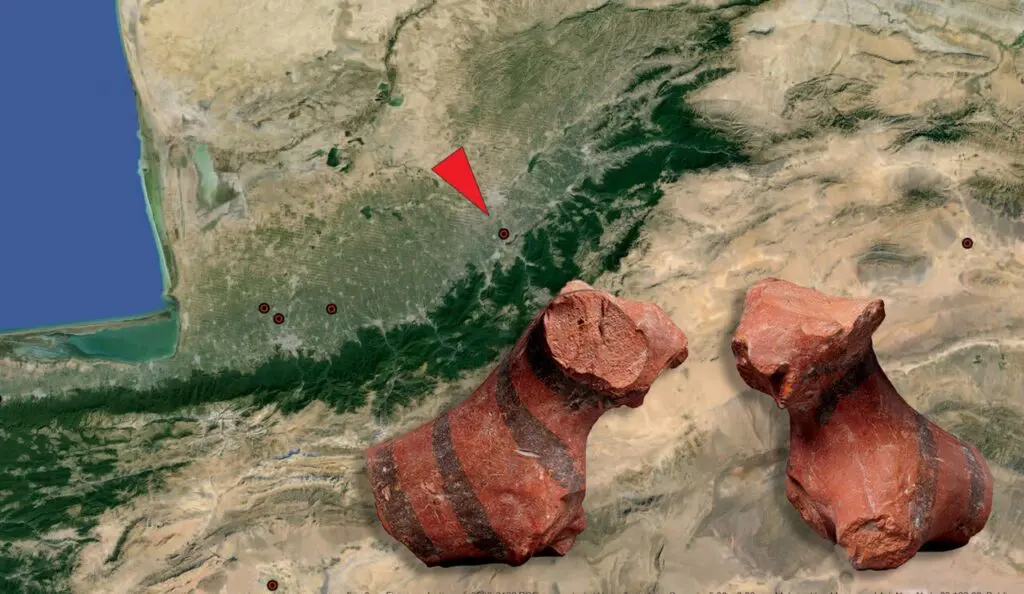
Archaeology rarely rewrites an entire symbol’s origin story. Yet a small clay fragment unearthed in northern Iran has done exactly that. The so-called Yarim Tepe tiger figurine, dated to around 3500–3100 BCE, is now believed to be the world’s oldest known tiger figurine — a piece of fired earth that carries five millennia of human fascination with power, wilderness, and the animal that once roamed the Hyrcanian forests along the Caspian Sea.
For decades, the tiger’s presence in Persian art was thought to be a late arrival, appearing only under the Sasanian Empire (3rd–7th centuries CE) when silver vessels showed nobles hunting striped cats as emblems of strength. But this 8-centimetre ceramic from Golestan Province — painted with dark, deliberate stripes — moves that timeline back by nearly three thousand years. It is more than an artifact: it is an echo of a vanished landscape and a vanished species, the Caspian tiger (Panthera tigris virgata).
A small tiger figurine with a vast story
The discovery itself is not new. It was excavated in 1960 at Yarim Tepe, a prehistoric mound near today’s Gonbad-e Kavus, and entered the Metropolitan Museum of Art’s collection three years later. What is new is the interpretation. In a recent Anthropozoologica study, Henry P. Colburn of Bryn Mawr College re-examined the fragment, comparing its painted motifs and clay composition to the broader ceramic family known as Caspian Black-on-Red Ware. His conclusion: this is not a stylized feline or abstract pattern but a conscious depiction of a tiger — and the oldest in Iran’s archaeological record.
Two curved black lines along the torso and another faint stripe on the neck reveal intention, not accident. “The patterning is deliberate,” Colburn writes. “It imitates the animal’s appearance and suggests direct familiarity rather than imported symbolism.” In other words, someone living 5,000 years ago had seen a tiger up close enough to remember its stripes.
Hyrcania: land of the lost tigers
To understand that intimacy, one must picture the ancient ecology of Hyrcania — the lush green belt stretching between the Alborz Mountains and the Caspian Sea. Today, these are the Hyrcanian Forests, a UNESCO World Heritage Site of temperate broadleaf trees. Five millennia ago, they were wilder still: red deer, boar, and the Caspian tiger shared the same humid valleys. The tiger figurine may have served as a votive offering, a household charm, or even a child’s toy, but it almost certainly reflected a living memory of these forests.
That link between environment and imagination would persist across centuries. Later Persian texts exalted the tiger as a creature of divine courage. In Ferdowsi’s Shahnameh, the warrior Rustam’s armor is called the babr-e bayān — literally “tiger-skin.” What began as a local observation in clay matured into an empire’s metaphor for heroism. The line from Yarim Tepe to Rustam’s cloak is not poetic license; it is cultural continuity.
From Chalcolithic craft to imperial symbol
Colburn’s re-dating of the artifact also dismantles a long-held scholarly bias: that Iran’s tiger motifs were imported from Central Asia or the Indus Valley. The tiger figurine shows the opposite. Long before empires traded imagery, Hyrcania was creating its own language of power. Nearby Chalcolithic sites — Shah Tepe, Tureng Tepe, Tepe Hissar — produced similar ceramics but no animal forms. Yarim Tepe stands alone, hinting at a local workshop where imagination met observation.
This insight resonates with what we explored in our cornerstone feature Tigers in Culture: Myths, Art and the Human Imagination. Across Asia, humans first represented tigers not as trophies but as intermediaries between fear and respect — figures that bound the community to its wilderness. The Iranian example adds an essential chapter to that shared narrative: a pre-literary symbol born from coexistence, not conquest.
When clay becomes memory
This tiger figurine’s survival is almost accidental. Its legs and back were lost long ago; only chest, neck, and part of the head remain. Yet its partial state mirrors the fate of the species it portrays. The Caspian tiger vanished from Iran by the 1950s, its forests logged and hunted bare. What survives of both animal and artifact are fragments — testimonies to what the region once was.
That loss gives the object a modern relevance far beyond archaeology. Cultural historians increasingly see artifacts like this as environmental archives: they record not only artistic style but biodiversity. The clay of Yarim Tepe holds fingerprints of people who lived with tigers; the soils that once held their tracks are now agricultural plains.
Even in its stillness, the tiger figurine speaks of movement — of migration, trade, myth, extinction, and rediscovery. Its journey from a Chalcolithic village to the Metropolitan Museum’s vitrines mirrors humanity’s own drift from intimacy with nature toward detached admiration behind glass.
Reinterpreting a symbol across millennia
For centuries, the tiger in Persian iconography has represented royal power, military prowess, and divine protection. But the tiger figurine predates those narratives; it reveals a pre-political relationship, one that was likely spiritual rather than imperial. The clay artist of this tiger figurine did not carve dominance — he carved recognition.
That distinction matters. Modern conservation often focuses on saving species as data points or genetic repositories. Yet the deep history of tiger symbolism shows that reverence was once experiential. People made art because they shared space with the animal. The more distant that coexistence became, the more stylized the tiger grew — eventually reduced to heraldry, armor, or luxury design.
An artifact like this tiger figurine forces us to rethink what “heritage” means. It is not only what we inherit from human ancestors but from non-human ones — from the creatures whose presence shaped our stories.
From figurine to philosophy
The Metropolitan Museum still lists the piece as “Animal figurine (possibly tiger).” The scholarly caution is fair, but the symbolic weight is undeniable. Five thousand years later, the same region that gave us this clay predator now bears the memory of its extinction. Iran’s Caspian tiger is gone, but the soil continues to yield reminders of coexistence older than empire itself.
Colburn’s study, published in Anthropozoo, underscores this temporal bridge. By connecting prehistoric craft to medieval epic, he shows that cultural memory can outlive biological reality — that art can preserve what ecology forgets. The tiger figurine is not simply art history; it is ecological testimony in miniature.
The silence after the stripes
Standing before the museum case today, one might see only a reddish shard with painted lines. But for anyone who knows what was lost in the Caspian forests, those stripes still move. They remind us that symbols can survive even when species cannot — a sobering paradox that defines modern conservation.
In the end, this tiny sculpture offers more than aesthetic wonder. It demands humility. The first Persian artist who drew tiger stripes on clay likely saw the animal drink from the same rivers that feed today’s farmlands. To that person, the tiger was neither myth nor memory — it was neighbor.
When we speak of tiger figurines today, we are really speaking of the human urge to remember power without possessing it. The oldest known tiger in art teaches the newest generation in science the same lesson: coexistence, once lost, can only be re-imagined, never restored.
Source: Arkeonews
Photo: Arkeonews