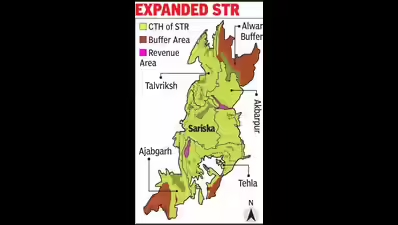
44000 hectares have been added to the Sariska Wildlife Sanctuary, a headline that appears promising for tiger conservation but raises immediate questions about which landscapes were included, which were excluded, and whether this enlargement genuinely strengthens the ecology of the reserve. Expanding protected land matters only when the added 44000 hectares support tiger movement, prey security and long-term survival. When expansion avoids contested or commercially valuable areas, the number becomes symbolic rather than strategic.
Expansion Of 44000 Hectares Helps Only If Critical Land Is Protected
The forest department announced that more than 44000 hectares of forest and revenue land are now part of Sariska, increasing the total notified area to over 98,762 hectares, as reported by Times of India. The decision followed a rationalisation of Critical Tiger Habitat boundaries reviewed by state and national wildlife authorities, a process meant to ensure scientific accuracy and ecological coherence.
Yet expanding by 44000 hectares means little if politically sensitive or ecologically rich regions are excluded. Tigers depend on habitat quality, not administrative volume. Secure movement corridors, intact forest blocks and prey-rich floodplains matter far more than numerical increases. When authorities choose land that is easy to add instead of land that is essential to protect, the map expands while the sanctuary’s tiger viability does not. This is the pattern repeatedly seen when political will decides the tiger’s future, where decisions about protected areas reflect influence, pressure and convenience rather than ecological necessity.
Tigers require dense cover, stable prey and undisturbed routes through the Aravalli landscape. Adding 44000 hectares to areas that already had low development pressure risks creating an illusion of protection rather than delivering genuine security.
Omissions In The 44000 Hectare Expansion Reveal Weaknesses
Environmentalists have already pointed out that the boundary review fails to protect key landscapes. Siliserh Lake, a biologically rich area supporting diverse wildlife, was excluded from the expansion despite repeated appeals. This zone provides habitat continuity and prey support for tigers and should have been part of any meaningful enlargement. Its omission suggests that the addition of 44000 hectares was shaped by political convenience, not ecological priority.
The Tehla area—another ecologically important region—was also left out. These exclusions indicate deliberate boundary shaping that avoids zones where commercial pressures, such as mining or infrastructure, remain strong. Expanding by 44000 hectares but excluding the most vulnerable lands is not a conservation victory; it is a redistribution of protection away from conflict with industry.
Residents noted another concern: densely populated areas of Thanagazi have now been brought within the sanctuary boundary. Including heavily inhabited zones risks long-term conflict and creates implementation challenges. Conservation boundaries should reduce human–wildlife interaction, not embed population centres within protected land.
Tigers Cannot Wait For Administration To Catch Up
Following the expansion, district collectors must review public objections and complete legal steps required under the Wildlife (Protection) Act. Such procedures take time. During this period, pressure on forests continues, potential mining interests regroup, and enforcement often lags. Tigers do not benefit from delays or from boundaries that remain unenforced.
The newly added 44000 hectares must receive on-ground protection immediately. Without ranger deployments, clear demarcation, and active management, the expansion risks becoming a paperwork milestone rather than a living safeguard. Tigers require functioning habitat today, not after months of bureaucratic processing.
The significance of adding 44000 hectares depends entirely on action. When political will defends ecological integrity, protected areas grow stronger. When decisions avoid controversy, the sanctuary grows on maps while remaining vulnerable to threats on the ground.
The Real Test Is How The 44000 Hectares Are Managed
The addition of 44000 hectares gives Sariska an opportunity to strengthen its ecological foundation, but only if the land added is protected with conviction. Authorities must reassess excluded regions, especially Siliserh Lake and Tehla, and protect landscapes threatened by mining. Tigers thrive when habitat expansions are guided by science, not by administrative arithmetic.
If the state enforces protection across all 44000 hectares, strengthens corridors and shields the sanctuary from extractive pressure, Sariska’s recovery may accelerate. If omissions persist and enforcement remains inconsistent, the expansion risks becoming a number celebrated publicly while the ecosystem continues to fray.
For Sariska, the measure of success is simple: whether the 44000 hectares meaningfully expand the landscape tigers depend on, or whether they merely expand the boundary of a map. Only decisive protection will determine which future unfolds.
Source: Times of India, India.
Photo: Times of India, India.