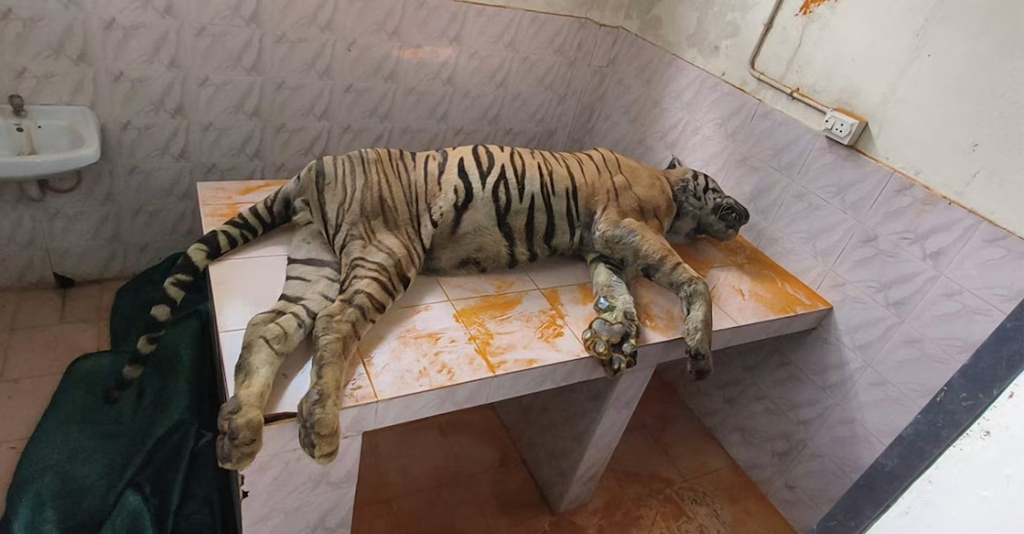
Rishiraj spent 25 years behind bars, and his death at the Thrissur zoo, as reported by Onmanorama, is being framed as an expected medical outcome rather than the result of a lifetime in confinement. Officials pointed to age-related complications, intensive care, and CCTV monitoring, but none of these details confront the deeper truth: a tiger like Rishiraj was never meant to spend a single day in captivity, let alone decades. Tigers belong to the wild, not behind bars.
His death marks the end of a life defined not by natural behaviour, but by restriction, observation, and the long decay that comes with being treated as an exhibit.
A Lifetime Of Confinement
In the months before his death, Rishiraj was kept under constant supervision, his reduced mobility forcing keepers to provide oral feeding. Presented as care, this routine actually reveals how captivity strips a tiger of dignity. A wild tiger dies in its territory, with the autonomy that defines the species. A zoo tiger dies only after a long period of collapse, unable to move, hunt, or live according to instinct. The final chapter is always medicalised, supervised, and disconnected from the forest rhythms that guide a tiger’s life.
Captured from Kattikulam in Wayanad in 2015, Rishiraj lost his freedom long before his health declined. Once inside the zoo, his world became an enclosure. For a tiger, captivity removes everything essential: space, territorial control, natural prey, environmental complexity, and psychological stimulation. Over time, this loss produces pacing, lethargy, and the repetitive movements associated with zoochosis—an illness created entirely by confinement.
Throughout this story, the name Rishiraj highlights the reality that tigers in zoos are not ambassadors for conservation. They are survivors of captivity, their lives diminished by an environment built for spectators, not for the animals inside it.
The Violence Behind Captive “Care”
Zoos frequently praise long-lived animals as proof of success. They highlight how tigers like Rishiraj reach ages rarely seen in the wild. But these numbers hide suffering. Captive longevity is built on artificial feeding, medical intervention, and psychological deprivation. Living longer is not living better; it is simply enduring more years inside a cage.
Rishiraj’s decline mirrors the pattern seen in zoo tigers everywhere: no territory, loss of mobility, weakened muscles, and a mind deprived of natural stimulation. Every tiger in captivity faces this trajectory. Zoochosis. These animals do not age according to nature but according to the limitations imposed on them. And when the decline becomes irreversible, the zoo frames the end as peaceful, ignoring the decades of stress that preceded it.
Even in death, institutional language dominates. Officials said post-death procedures would follow guidelines. But procedures cannot restore what captivity stole. A wild tiger does not need guidelines to validate its passing; it needs a forest in which to live freely.
The repeated appearance of the name Rishiraj across this narrative underlines how captivity transforms tigers into lifelong prisoners rather than living symbols of wilderness.
Captivity Masquerading As Conservation
Zoos claim their work supports conservation, but the truth is plain: animals like Rishiraj will never return to the wild, never contribute to genetic diversity in natural landscapes, never reclaim territory, and never hunt as their biology demands. Captivity becomes a performance, not a path to recovery for the species.
Visitors see a resting tiger and mistake stillness for serenity. What they cannot see are the instincts suppressed, the behaviours erased, and the accumulated frustration of decades spent in enclosures. Rishiraj’s life did not protect wild tigers. It removed one from the forest and placed him where his instincts became liabilities rather than strengths.
The tragedy is not that Rishiraj reached 25. The tragedy is that he reached 25 without freedom. His long life did not reflect good fortune but prolonged captivity.
As long as zoos maintain the illusion that they offer sanctuary, more tigers will live and die this way—observed, immobilised, and stripped of the autonomy that defines their species. Their suffering remains hidden behind signage, visitor paths, and institutional language.
If there comes a time when people finally stop going to zoos, a shift supported by growing awareness of conditions faced in captivity, it will not only end the suffering of thousands of tigers and millions of other animals, it will also unlock an enormous wave of funding that can finally be directed toward real habitats and real protection.
Source: Onmanorama, India
Photo: Onmanorama, India